The return of the lists!
We are now well into Oscarbait season and my thoughts can be pretty easily summed up in this comic here: http://multiplexcomic.com/strip/541. It's a time of good and bad movies and movies in-between. As such, it is also now time to account for the movies I have seen and the movies I plan to see. Here are my lists in all of their excitement:
Likely/Possible/Longshot Contenders I Have Seen:
- Alice in Wonderland (unfortunately)
- Black Swan
- Despicable Me
- Harry Potter and the Deathly Hallows Part I
- How to Train Your Dragon
- Inception
- Love and Other Drugs
- Shrek Forever After (also unfortunately)
- The Social Network
- Shutter Island
- Tangled
- The Town
- Toy Story 3
- Tron: Legacy
Likely/Possible/Longshot Contenders I Plan to See/Might See:
- 127 Hours
- Animal Kingdom
- Another Year
- Blue Valentine
- Exit Through the Gift Shop
- The Fighter
- Get Low
- I Love You, Phillip Morris
- The Illusionist
- Inside Job
- The Kids Are All Right
- The King's Speech
- Made in Dagenham
- Never Let Me Go
- Rabbit Hole
- True Grit
- Uncle Boonmee Who Can Recall His Past Lives
- Waiting for "Superman"
- The Way Back
- Winter's Bone
...Well, that's a more even split than I expected. Obvs certain films, like I Love You Phillip Morris, are less likely to be major contenders, but I am too curious to not see that film for myself. Not sure when I can get my hands on Uncle Boonmee, but I am immensely curious about it. I know this probably isn't a good thing on my part, but I want to wait to rent 127 Hours because I am squeamish about things like arms getting chopped off and would rather avoid a big screen and intense theater experience for that. Also not sure when Another Year or The Way Back will make their way towards a theater near me, but I'll work it out.
I'd have liked to see The Social Network again, and I will before the awards season is over, but not in theaters. I'm sure I'll do some sort of massive movie update - I saw Tron on Tuesday, Black Swan on Wednesday, and Love and Other Drugs on Thursdays - soon, but as it is late Christmas Eve, I'll leave it at the lists for now.
Happy hols and awards season!
PS: Since there is so much yet to see, I likely will either not do a Best Of 2010 list or else it will come probably in 2011. Not that the world needs another Best Of list, so chances are I might forgo it all together and just write about the movies I've seen and liked.
Friday, December 24, 2010

Sunday, November 14, 2010
Thoughts on Children's Lit
It's been a while since my last post hasn't it been? Well, not to get too personal, but I've been having a rough semester and a very busy one at that. My film production class has left me wondering how I managed to even make it into the film department, my screenwriting class is kicking my butt at this exact moment with too much homework, and even my hundred-level religion class resulted in a shittily graded paper.
But do you want to know what is going pretty freakin' well this semester? My Children's Lit class.
I was just rereading my earlier blog post about The Girl Who Owned a City and thought that I would like to revisit my thoughts from that post about children's literature. I know, this is more of a movies and television blog and I certainly could rant about how this season of Dexter has been so slow or say how I've given up on House for now or commend Community on doing what it does best. I could rave about The Social Network or get unnecessarily excited over going to the new Harry Potter movie midnight release on Thursday night, but I'd much rather discuss the real shining beacon in my life right now, which is, surprisingly, this lit class.
Not that it's perfect. My first paper wasn't great, I haven't had time to do more than a general outline for the paper due this Wednesday, and I'm close but not quite at A level. I've finished some of the reading a bit after it was technically due and I've still yet to cover Twilight in the class, but there are so many interesting things to take away from this class, none of which I can do justice in a blog post at 1:30am, but I can give you a quick survey of the genius that is this class and this subject and my own personal relationship with children's texts.
We kicked off the semester with an excerpt from Alice in Wonderland, but not the whole text (originally on the syllabus, but, amongst a few others such as The Giver, Alice in Wonderland was cut in the end). The Wind in the Willows was next in all its episodic glory (my favorite being Rat's interactions with the traveling Rat he meets). The Secret Garden introduced me to Dickon and re-introducing me to creepy crushes on children (this would continue with Will Parry as I was inspired to reread The Subtle Knife during my "free time"). I even ventured into the world of fan fiction veer so briefly before realizing that writing Dickon's manner of speech accurately removed any sexiness. My desires for attractiveness and accuracy conflicted. Peter and Wendy told me that I really just didn't like the story of Peter Pan very much after all. The Twins at St. Clare's reminded me of my childhood addiction to series like The Boxcar Children and The Babysitter's Club: basic children's books that nobody really takes seriously after a certain age. The Lion, The Witch, and the Wardrobe told me that, no, I don't like Narnia and The Last Battle that The Amber Spyglass did religion better. Also, we approached The Problem of Susan, and I started to get my ideas for my coming paper, wanting to approach my gender's role in all of this. What's so wrong with wanting invitations and nylons? On the flipside, we went over to The Golden Compass, one of my favorite books ever, and I was reminded how great the characters were and how one of my future cats should be named Iorek. The Ear, the Eye, and the Arm showed me another female character, though not the main protagonist, that I had originally written off but embraced by the end. Howl's Moving Castle was brilliant and I wonder how I'd never read it as a child. Officially decided another future cat shall be named Howl. I was also reminded that I am a sucker for a good literary romance - what's so wrong with Sophie and Howl having a happily ever after? Many of my classmates contested. Perhaps it's best we only read The Golden Compass and didn't introduce my beloved Will Parry. The Devil's Arithmetic brought me back to my middle school reading habits: American Revolution or Holocaust children's literature. How depressing! Magic made a comeback and time travel and another female protagonist, how fantastic! Finally, most recently, we've come to a collection of picture books and Roald Dahl's Revolting Rhymes. I don't remember ever reading any of the books: Where the Wild Things Are, Pat the Bunny, Goodnight Moon, Harold and the Purple Crayon, William's Doll, or Princess Smartypants.
Just take a glimpse through my notes from class sometime and you'll see a crazy amalgamation of ideas and concepts because in examining children's literature, it's not unlike examining adult's literature - there's quite a bit of everything. Adults have serialized literature that may not be brilliantly written, adults have historical drama and stories steeped in gender roles and fantasy and religion and science fiction. But when examining a whole group of literature, I never want to stop reading. I realized that today as I sat in the library, reading from our Oxford companion, filled with interesting essays on different topics in children's literature, we'd only read seven chapters of sixteen. I wanted to read them all! In fact, I want to read the gender roles chapter in time for my paper. I want to read the other dozens of books referenced.
Literature feels like a much more endless supply than movies or television. Not that one could watch the entirety of cinematic or televised history in a lifetime, but those mediums are so different from novels and poetry and essays and everything in-between. Children's movies are interesting and all, but there's something so much narrower about that library than the library of children's books. For exampls, film versions of these stories. Howl's Moving Castle was completely redefined and centered around a tale Miyazaki wanted to tell rather than the actual book's plot. The Narnia movies were even more ridiculous than the books, in my opinion. The Golden Compass, while well-cast, was watered down. I still have yet to see The Secret Garden. Peter Pan, the animated version, tries to simplify a simple story. Peter Pan, the live-action 2003 film, takes a completely different approach to the material, one which I might even like more than the book. And while Where the Wild Things is a good movie, in my opinion, it is an elongated version of the picture book from which the title hails. And that movie wasn't really made for kids so much as nostalgic adults.
There's a much more stream-lined narrative and style for "children's movies" than for children's books. Some of the worries centered around children's literature are much more apparent in movies for kids. Whereas some books are overly instructive or didactic, most movies for children are built around some life lesson moral that is hammered into the audience. Even in well-made features, such as Howl's Moving Castle, there is no escaping something so very clear. And gender roles are even worse in film, generally speaking.
I've always thought to myself which movies I would want to show my non-existent kids, being mostly a movie person. But I'm more interested now in understanding what books I also want them to read. The television I want them to watch. The games and toys I want them to enjoy. There is so much to learn, but even more to simply observe, to enjoy conflicting narratives that teach different lessons, allowing my kids their own agency of decision-making. It's easy to forget that kids aren't people too, but I'm still somewhat young enough to remember how intensely I thought about certain things and how not-intensely I thought about others.
Now is different. Now I see anything and I'm almost afraid I might over-analyze it. Everyday conversations involve some semblance of intellectualism. Ahh, college students, how they converse and interact. How they drag in the challenging of the concept of canon based on their children's lit reading from a couple weeks ago. But it feels so good to talk about those things, to have that perspective. Some might call it snobbery or elitism or silly to waste time learning about children's lit but there are so many ways to understand children, a huge part of this world, and one of which is to observe what goes into these texts and what comes out, whether it be in a college classroom or a child's bedroom.
My apologies for making this blog post so inherently steeped in my personal life. Unfortunately, I really don't have strong opinions about any movies or television I've watched lately (well, maybe except that the last few episodes of Glee have been a huge step up since the back nine, which were sometimes essentially unwatchable). Oh, well, I guess there's one big announcement: amidst my personal ~drama, I've started watching The Wire, which I am understanding to be one of the best television shows ever? Well, I'm certainly liking it. Liking it enough to start the second season rather than read the screenplays I need to for Tuesday.
But do you want to know what is going pretty freakin' well this semester? My Children's Lit class.
I was just rereading my earlier blog post about The Girl Who Owned a City and thought that I would like to revisit my thoughts from that post about children's literature. I know, this is more of a movies and television blog and I certainly could rant about how this season of Dexter has been so slow or say how I've given up on House for now or commend Community on doing what it does best. I could rave about The Social Network or get unnecessarily excited over going to the new Harry Potter movie midnight release on Thursday night, but I'd much rather discuss the real shining beacon in my life right now, which is, surprisingly, this lit class.
Not that it's perfect. My first paper wasn't great, I haven't had time to do more than a general outline for the paper due this Wednesday, and I'm close but not quite at A level. I've finished some of the reading a bit after it was technically due and I've still yet to cover Twilight in the class, but there are so many interesting things to take away from this class, none of which I can do justice in a blog post at 1:30am, but I can give you a quick survey of the genius that is this class and this subject and my own personal relationship with children's texts.
We kicked off the semester with an excerpt from Alice in Wonderland, but not the whole text (originally on the syllabus, but, amongst a few others such as The Giver, Alice in Wonderland was cut in the end). The Wind in the Willows was next in all its episodic glory (my favorite being Rat's interactions with the traveling Rat he meets). The Secret Garden introduced me to Dickon and re-introducing me to creepy crushes on children (this would continue with Will Parry as I was inspired to reread The Subtle Knife during my "free time"). I even ventured into the world of fan fiction veer so briefly before realizing that writing Dickon's manner of speech accurately removed any sexiness. My desires for attractiveness and accuracy conflicted. Peter and Wendy told me that I really just didn't like the story of Peter Pan very much after all. The Twins at St. Clare's reminded me of my childhood addiction to series like The Boxcar Children and The Babysitter's Club: basic children's books that nobody really takes seriously after a certain age. The Lion, The Witch, and the Wardrobe told me that, no, I don't like Narnia and The Last Battle that The Amber Spyglass did religion better. Also, we approached The Problem of Susan, and I started to get my ideas for my coming paper, wanting to approach my gender's role in all of this. What's so wrong with wanting invitations and nylons? On the flipside, we went over to The Golden Compass, one of my favorite books ever, and I was reminded how great the characters were and how one of my future cats should be named Iorek. The Ear, the Eye, and the Arm showed me another female character, though not the main protagonist, that I had originally written off but embraced by the end. Howl's Moving Castle was brilliant and I wonder how I'd never read it as a child. Officially decided another future cat shall be named Howl. I was also reminded that I am a sucker for a good literary romance - what's so wrong with Sophie and Howl having a happily ever after? Many of my classmates contested. Perhaps it's best we only read The Golden Compass and didn't introduce my beloved Will Parry. The Devil's Arithmetic brought me back to my middle school reading habits: American Revolution or Holocaust children's literature. How depressing! Magic made a comeback and time travel and another female protagonist, how fantastic! Finally, most recently, we've come to a collection of picture books and Roald Dahl's Revolting Rhymes. I don't remember ever reading any of the books: Where the Wild Things Are, Pat the Bunny, Goodnight Moon, Harold and the Purple Crayon, William's Doll, or Princess Smartypants.
Just take a glimpse through my notes from class sometime and you'll see a crazy amalgamation of ideas and concepts because in examining children's literature, it's not unlike examining adult's literature - there's quite a bit of everything. Adults have serialized literature that may not be brilliantly written, adults have historical drama and stories steeped in gender roles and fantasy and religion and science fiction. But when examining a whole group of literature, I never want to stop reading. I realized that today as I sat in the library, reading from our Oxford companion, filled with interesting essays on different topics in children's literature, we'd only read seven chapters of sixteen. I wanted to read them all! In fact, I want to read the gender roles chapter in time for my paper. I want to read the other dozens of books referenced.
Literature feels like a much more endless supply than movies or television. Not that one could watch the entirety of cinematic or televised history in a lifetime, but those mediums are so different from novels and poetry and essays and everything in-between. Children's movies are interesting and all, but there's something so much narrower about that library than the library of children's books. For exampls, film versions of these stories. Howl's Moving Castle was completely redefined and centered around a tale Miyazaki wanted to tell rather than the actual book's plot. The Narnia movies were even more ridiculous than the books, in my opinion. The Golden Compass, while well-cast, was watered down. I still have yet to see The Secret Garden. Peter Pan, the animated version, tries to simplify a simple story. Peter Pan, the live-action 2003 film, takes a completely different approach to the material, one which I might even like more than the book. And while Where the Wild Things is a good movie, in my opinion, it is an elongated version of the picture book from which the title hails. And that movie wasn't really made for kids so much as nostalgic adults.
There's a much more stream-lined narrative and style for "children's movies" than for children's books. Some of the worries centered around children's literature are much more apparent in movies for kids. Whereas some books are overly instructive or didactic, most movies for children are built around some life lesson moral that is hammered into the audience. Even in well-made features, such as Howl's Moving Castle, there is no escaping something so very clear. And gender roles are even worse in film, generally speaking.
I've always thought to myself which movies I would want to show my non-existent kids, being mostly a movie person. But I'm more interested now in understanding what books I also want them to read. The television I want them to watch. The games and toys I want them to enjoy. There is so much to learn, but even more to simply observe, to enjoy conflicting narratives that teach different lessons, allowing my kids their own agency of decision-making. It's easy to forget that kids aren't people too, but I'm still somewhat young enough to remember how intensely I thought about certain things and how not-intensely I thought about others.
Now is different. Now I see anything and I'm almost afraid I might over-analyze it. Everyday conversations involve some semblance of intellectualism. Ahh, college students, how they converse and interact. How they drag in the challenging of the concept of canon based on their children's lit reading from a couple weeks ago. But it feels so good to talk about those things, to have that perspective. Some might call it snobbery or elitism or silly to waste time learning about children's lit but there are so many ways to understand children, a huge part of this world, and one of which is to observe what goes into these texts and what comes out, whether it be in a college classroom or a child's bedroom.
My apologies for making this blog post so inherently steeped in my personal life. Unfortunately, I really don't have strong opinions about any movies or television I've watched lately (well, maybe except that the last few episodes of Glee have been a huge step up since the back nine, which were sometimes essentially unwatchable). Oh, well, I guess there's one big announcement: amidst my personal ~drama, I've started watching The Wire, which I am understanding to be one of the best television shows ever? Well, I'm certainly liking it. Liking it enough to start the second season rather than read the screenplays I need to for Tuesday.
Friday, October 22, 2010
"Emmy" TV Shows. Not Unlike "Oscar" Movies.
Sorry for the long absence. I'm a busy student/employee/television addict/etc.
But as I catch up on last night's television shows, I started to wonder to myself about "the Academy." See, lots of people complain, whine, and moan over both the Academy that decides the Emmys and the Oscars. The thing is, though, I haven't seen many people spend all year discussing the Emmys, declaring this show an Emmy show and that show not an Emmy show, whereas even everyday movie-goers will easily be talking about the Oscar chances for The Social Network or Toy Story 3.
At first glance, this might indicate that the selectivity for the Emmys is not so severe as it is for the Oscars. You'd think an Academy that would nominate True Blood might actually have its marbles in a way an Academy that shut out The Dark Knight doesn't. I think though that you'd be wrong. True Blood, for example, has certain things going for it, including an Academy Award-winning main actress, a respected premium cable channel, and a "message" (y'know, how vampire rights in the show parallel modern day LGBT rights).
Don't fool yourself; the Emmys like the same things the Oscars do. Pedigree isn't everything though, as former Academy Award nominees Mary McDonnell and Edward James Olmos will tell you, having worked for years on a never-nominated critically-acclaimed little series called Battlestar Galactica everyone who knows me knows that I adore. It takes a certain class that comes, especially these days, with being on a premium cable network, which is why even though I haven't seen an episode of Boardwalk Empire, I'm convinced it will land several nominations next year. Because it's on HBO, it's classy like Mad Men, and it takes itself seriously.
As I'm sure the Buffy fans have lamented for ages, taking yourself seriously can be a big thing. I feel like one of the more common complaints about Mad Men would be a sort of "stuffiness" about it, coming from its slow, melodious pace and seriously fragmented (and often disliked) characters.
But the comedy category, you declare! Comedic shows are appreciated for irony! Just look at Glee? Though I decry Glee and watch it, such a contradiction as I am, Glee is actually something of an interesting anomaly in my opinion. It's a high school show, it's a musical, its pedigree is really not that impressive (Matthew Morrison and Lea Michele are the main show there - I won't count Jane Lynch, despite loving her more, because an unfortunate amount of not-young people don't realize how much she did pre-Glee). Glee's popularity comes from a more modern High School Musical approach - but you didn't see High School Musical get nominated for Best TV Movie, did you? Despite whatever sucks about Glee, it is kind of impressive for it to have gotten the formal recognition it has.
Besides Glee, however, the comedy area remains pretty locked for sitcoms and serious premium cable comedies (i.e. Weeds, Entourage, Curb Your Enthusiasm). And, to be honest, the only reason Glee might get nominated again next year is because the current freshmen sitcoms are rather slim pickings, so I'd be prepared for a full-on repeat in the comedy series category.
Sitcoms are cute and quaint. They're very old-fashioned. Even Modern Family, which I watch and like and is lauded for its advancement, follows your old-school format of following a family around and seeing all their funny, morally-inclined hi-jinks in a short half hour. If there was a movie equivalent to sitcoms, actually, which there really isn't anymore, I'd be surprised if it got nominated for the Oscars, actually, because that area is even too backwater for them. When people talk about potential Oscar comedies, they think of raucous shit like The Hangover, which is more of a premium cable type show than a typical network sitcom.
But back to the drama category, where this all started for me as I thought longingly of The Vampire Diaries, the shockingly good show I have fallen in love with despite not being a big vampire fan and aware enough of trends to usually not be susceptible without my consent. The Vampire Diaries is a good show, hands down. Interesting characters, good plots, amazing pacing, problems are rectified, everything is reasonable, and as a bonus, the cast is gorgeous (and, so far as I'm aware, come across as respectable and scandal-free). The problems? The show doesn't take itself so seriously. Not in the same way, say, my beloved Chuck does, becoming a little bit too much of a self-parody at times, but there is an air of fun and danger that comes from a show willing to take risks, kill off a main character pretty quickly, and do a lot of things most shows aren't really willing to do. Second, the show doesn't have pedigree. It's highest pedigree right now is probably Ian Somerhalder, best known otherwise for his season-long and small recurring bit as Boone on Lost. Nina Dobrev did Degrassi. Matt Davis might be most recognizable for Legally Blonde. Seriously, this is not your A-list cast. But they're not just pretty, they're good. And, finally, The Vampire Diaries is on The CW. The CW may technically be a network station, but it is essentially trash to the bigwigs. The CW is home of Smallville and Gossip Girl, not a show that's better than Emmy-nominated True Blood (sorry, TB fans, I'm with you, but did you see the third season compared to TVD? Just, no).
Everything that might make a series worthy of Emmy recognition is simply not in this show, which is probably derided by people who've never seen it as part of the Twilight craze, as a teen drama with lots of skimpy clothes and scandal. I'm sorry, but this is neither True Blood nor Gossip Girl; there are few if none unnecessary shenanigans. High school is a setting, not a defining characteristic of the show (especially as of late; Mystic Falls is more the setting anyway, one of the coolest, cult-like towns ever). Skimpy clothes? Are you kidding me? Besides the car wash episode, there have been so few scantily clad moments. I can remember all of one legitimate sex scene in the entirety of this series. There are some sexy flashbacks, but it is nothing compared to the wild orgies of True Blood season 2, or even the least sexy of True Blood episodes. Scandals? I bet there are about five thousand more scandals in a single episode of Desperate Housewives than a full season of The Vampire Diaries. Vampire Diaries is more concerned with drama and action and zigzagging plots and surprises than with the kind of ~drama that fuels shows like Gossip Girl or One Tree Hill or Gilmore Girls (which I loved, but was soapy as hell sometimes).
Essentially, every stigma that The Vampire Diaries would attract is false. But that's true about a lot of shows that would never qualify for an Emmy nomination. There is no "Blind Side" slot in the Emmy nominees. The Emmys are probably even more out of touch with popular culture than the Oscars. Sci-fi has been at the Oscars for ages, from Star Wars to Avatar (more of a crowd-pleaser than it's-all-about-the-analogy District 9). Battlestar Galactica, despite being declared by many as one of the best DRAMA television shows ever, or at least a very good one in general, never got more than a technical nod at the Emmys.
So we bitch and moan and complain a lot about the Oscars, about the Academy Awards being old and how certain great movies will never be Oscar movies, but the Emmys are no better, if they're not even worse, especially since they can repeat old favorites in place of strong up-comers. While movies year after year can emulate and imitate older films, keeping that certain "old Hollywood" or "period movie" place in the Best Picture nominee line-up, Emmys can literally keep the same show in the running, even past its prime (I mean really? House? That show has been good at best, horrendous at worst, and meh most of the time for a couple seasons now).
And yet, few shows are looked at, saying, "this show was made for the Emmys" when one could look at, say, The King's Speech, and declare immediately "it's an Oscar movie!" There isn't a lot different between what makes television and movies appeal for "bigwig" Academies. If anything, audience size and critics matter more for the Oscars - I doubt you'll find many champions of House's last season (praise the mental institute episode all you want, there are over twenty other episodes in the season), but even The Blind Side was well-received by many, though certainly not everyone. House's audience has dwindled (and it was probably the most-watched series nominated for Best Comedy/Drama last year; remember, Glee's audience was pretty modest for most of the first season), but Avatar, District 9, The Blind Side, and Up were huge money-makers.
My point has been made clear by this point. Just like with the Oscars and movies, there will be brilliant shows that will never win an Emmy, that never won an Emmy, and probably were never seen by those who vote on the Emmys. And that's disappointing, sure, but that's life, and tastes change, though slowly, and one day all the types of shows we champion now will be detested by future generations as backwards and unworthy of admiration and we'll be clinging on.
But as I catch up on last night's television shows, I started to wonder to myself about "the Academy." See, lots of people complain, whine, and moan over both the Academy that decides the Emmys and the Oscars. The thing is, though, I haven't seen many people spend all year discussing the Emmys, declaring this show an Emmy show and that show not an Emmy show, whereas even everyday movie-goers will easily be talking about the Oscar chances for The Social Network or Toy Story 3.
At first glance, this might indicate that the selectivity for the Emmys is not so severe as it is for the Oscars. You'd think an Academy that would nominate True Blood might actually have its marbles in a way an Academy that shut out The Dark Knight doesn't. I think though that you'd be wrong. True Blood, for example, has certain things going for it, including an Academy Award-winning main actress, a respected premium cable channel, and a "message" (y'know, how vampire rights in the show parallel modern day LGBT rights).
Don't fool yourself; the Emmys like the same things the Oscars do. Pedigree isn't everything though, as former Academy Award nominees Mary McDonnell and Edward James Olmos will tell you, having worked for years on a never-nominated critically-acclaimed little series called Battlestar Galactica everyone who knows me knows that I adore. It takes a certain class that comes, especially these days, with being on a premium cable network, which is why even though I haven't seen an episode of Boardwalk Empire, I'm convinced it will land several nominations next year. Because it's on HBO, it's classy like Mad Men, and it takes itself seriously.
As I'm sure the Buffy fans have lamented for ages, taking yourself seriously can be a big thing. I feel like one of the more common complaints about Mad Men would be a sort of "stuffiness" about it, coming from its slow, melodious pace and seriously fragmented (and often disliked) characters.
But the comedy category, you declare! Comedic shows are appreciated for irony! Just look at Glee? Though I decry Glee and watch it, such a contradiction as I am, Glee is actually something of an interesting anomaly in my opinion. It's a high school show, it's a musical, its pedigree is really not that impressive (Matthew Morrison and Lea Michele are the main show there - I won't count Jane Lynch, despite loving her more, because an unfortunate amount of not-young people don't realize how much she did pre-Glee). Glee's popularity comes from a more modern High School Musical approach - but you didn't see High School Musical get nominated for Best TV Movie, did you? Despite whatever sucks about Glee, it is kind of impressive for it to have gotten the formal recognition it has.
Besides Glee, however, the comedy area remains pretty locked for sitcoms and serious premium cable comedies (i.e. Weeds, Entourage, Curb Your Enthusiasm). And, to be honest, the only reason Glee might get nominated again next year is because the current freshmen sitcoms are rather slim pickings, so I'd be prepared for a full-on repeat in the comedy series category.
Sitcoms are cute and quaint. They're very old-fashioned. Even Modern Family, which I watch and like and is lauded for its advancement, follows your old-school format of following a family around and seeing all their funny, morally-inclined hi-jinks in a short half hour. If there was a movie equivalent to sitcoms, actually, which there really isn't anymore, I'd be surprised if it got nominated for the Oscars, actually, because that area is even too backwater for them. When people talk about potential Oscar comedies, they think of raucous shit like The Hangover, which is more of a premium cable type show than a typical network sitcom.
But back to the drama category, where this all started for me as I thought longingly of The Vampire Diaries, the shockingly good show I have fallen in love with despite not being a big vampire fan and aware enough of trends to usually not be susceptible without my consent. The Vampire Diaries is a good show, hands down. Interesting characters, good plots, amazing pacing, problems are rectified, everything is reasonable, and as a bonus, the cast is gorgeous (and, so far as I'm aware, come across as respectable and scandal-free). The problems? The show doesn't take itself so seriously. Not in the same way, say, my beloved Chuck does, becoming a little bit too much of a self-parody at times, but there is an air of fun and danger that comes from a show willing to take risks, kill off a main character pretty quickly, and do a lot of things most shows aren't really willing to do. Second, the show doesn't have pedigree. It's highest pedigree right now is probably Ian Somerhalder, best known otherwise for his season-long and small recurring bit as Boone on Lost. Nina Dobrev did Degrassi. Matt Davis might be most recognizable for Legally Blonde. Seriously, this is not your A-list cast. But they're not just pretty, they're good. And, finally, The Vampire Diaries is on The CW. The CW may technically be a network station, but it is essentially trash to the bigwigs. The CW is home of Smallville and Gossip Girl, not a show that's better than Emmy-nominated True Blood (sorry, TB fans, I'm with you, but did you see the third season compared to TVD? Just, no).
Everything that might make a series worthy of Emmy recognition is simply not in this show, which is probably derided by people who've never seen it as part of the Twilight craze, as a teen drama with lots of skimpy clothes and scandal. I'm sorry, but this is neither True Blood nor Gossip Girl; there are few if none unnecessary shenanigans. High school is a setting, not a defining characteristic of the show (especially as of late; Mystic Falls is more the setting anyway, one of the coolest, cult-like towns ever). Skimpy clothes? Are you kidding me? Besides the car wash episode, there have been so few scantily clad moments. I can remember all of one legitimate sex scene in the entirety of this series. There are some sexy flashbacks, but it is nothing compared to the wild orgies of True Blood season 2, or even the least sexy of True Blood episodes. Scandals? I bet there are about five thousand more scandals in a single episode of Desperate Housewives than a full season of The Vampire Diaries. Vampire Diaries is more concerned with drama and action and zigzagging plots and surprises than with the kind of ~drama that fuels shows like Gossip Girl or One Tree Hill or Gilmore Girls (which I loved, but was soapy as hell sometimes).
Essentially, every stigma that The Vampire Diaries would attract is false. But that's true about a lot of shows that would never qualify for an Emmy nomination. There is no "Blind Side" slot in the Emmy nominees. The Emmys are probably even more out of touch with popular culture than the Oscars. Sci-fi has been at the Oscars for ages, from Star Wars to Avatar (more of a crowd-pleaser than it's-all-about-the-analogy District 9). Battlestar Galactica, despite being declared by many as one of the best DRAMA television shows ever, or at least a very good one in general, never got more than a technical nod at the Emmys.
So we bitch and moan and complain a lot about the Oscars, about the Academy Awards being old and how certain great movies will never be Oscar movies, but the Emmys are no better, if they're not even worse, especially since they can repeat old favorites in place of strong up-comers. While movies year after year can emulate and imitate older films, keeping that certain "old Hollywood" or "period movie" place in the Best Picture nominee line-up, Emmys can literally keep the same show in the running, even past its prime (I mean really? House? That show has been good at best, horrendous at worst, and meh most of the time for a couple seasons now).
And yet, few shows are looked at, saying, "this show was made for the Emmys" when one could look at, say, The King's Speech, and declare immediately "it's an Oscar movie!" There isn't a lot different between what makes television and movies appeal for "bigwig" Academies. If anything, audience size and critics matter more for the Oscars - I doubt you'll find many champions of House's last season (praise the mental institute episode all you want, there are over twenty other episodes in the season), but even The Blind Side was well-received by many, though certainly not everyone. House's audience has dwindled (and it was probably the most-watched series nominated for Best Comedy/Drama last year; remember, Glee's audience was pretty modest for most of the first season), but Avatar, District 9, The Blind Side, and Up were huge money-makers.
My point has been made clear by this point. Just like with the Oscars and movies, there will be brilliant shows that will never win an Emmy, that never won an Emmy, and probably were never seen by those who vote on the Emmys. And that's disappointing, sure, but that's life, and tastes change, though slowly, and one day all the types of shows we champion now will be detested by future generations as backwards and unworthy of admiration and we'll be clinging on.
Wednesday, September 29, 2010
Glee: The Rachel Problem & More
Been a little busy with the kick-off of the semester, but I'm going to try for a minor new blog post.
So. Glee.

Sometimes cute. Often talented. And also quite often a piece of gooey, unkempt, poorly-defined messes.
I like Glee for some reasons, I really do. The cast is talented, there have been some stronger episodes (particularly toward the beginning of the first season), the musical numbers are usually quite entertaining, and lately when the show just gives in to its messes (i.e. Power of Madonna and last night's Brittany/Britney) it is quite enjoyable in that format. I mentioned earlier to a friend that if Glee just devolved into incoherent musical numbers (which, to an extent, it already does) I'd still watch it and truly enjoy it for the variety/cabaret like quality it could be and is best at.
There are also many problems with Glee. The writing is often weak, continuity is crap, the "realism" is pathetic, and the treatment of minorities often stumbles off the fine-line between embracing and exposing stereotypes, not to mention giving heavy-handed speeches hand-in-hand with satirical nonsense. It's these weaknesses that make me think Glee could be just as successful and twice as entertaining if it abandoned plot all together and just played with its cast of characters as is and ran it like the best, most epic variety show/cabaret. I've always wanted cabarets to make a comeback though...
Amongst my many issues with Glee, I'd probably say the biggest one right now has a name: Rachel.

Sure, many of the characters are mishandled, underused, overused, given too much credit for their lack of abilities (I'm looking at Finn's singing AND dancing), etc.... but Rachel really takes the cake for me.
The thing is, Lea Michele is undeniably talented. She's got a great voice. I'm not sure if it's my favorite voice, but it's definitely good. Clearly, it makes sense that Rachel is often the lead. She's assertive and talented. The problem? She's an unrestrained diva who never learns from her many mistakes. Rachel is not only annoying, she is often insufferable. All together, these two episodes in the second season, I think I may have liked her for all of about ten seconds, in the latest episode, when she tells Finn that she'll stop being controlling since she's discovered her own empowerment. AWESOME. GREAT. ...and then, she goes back to her crazy, dramatic ultimatums. And I think to myself, WHO DOES THIS? What kind of crazy pills is this girl on?
Rachel has no redeeming qualities. Her personality is horrible. She is controlling, obnoxious, rude, self-centered, and displays somewhat sociopath-like behavior (her "I'm doing this because I love you" shtick in the season opener, much?). Rachel also has an obsessive personality, which means when she gets on about something, she harps on about it incessantly, because she's also a loud-mouth. Sure, she "owns up" to her mistakes, sometimes, but then she goes and does another horrible thing next week. And whoops, again, and then another thing, and then she's got a clean-slate again. Seriously, I used to wonder what Rachel saw in Finn, but what the hell does Finn see in Rachel? She's pretty and talented, and that's about it.
And the show exploits this. The show is convinced that Rachel is our hero, that Rachel really does mean well, and that Rachel is worth loving despite her flaws... because why? Because she sings really, really well, and here, let's demonstrate by having her sing a big, dramatic number at the end of the episode (the modus operendi for this season thus far, and used a bit last season as well - Episodes 2, 17, and 18). We're led to believe that Rachel is redeemed because she sings a heartfelt song, but she still resorted to crazy-ass, selfish means to keep Sunshine out of the club, and she still gave Finn a crazy-ass, selfish ultimatum. I don't see how being talented makes up for being a shitty person.
Rachel is the center of Glee's problems for me, because Glee has disillusioned itself into seeing her as someone that she really does not come off as: a victim. In the first season, somewhat, when Finn was actively ditching her, I could see it, but now she's only a victim of her own behavior. Likewise, Glee has disillusioned itself into seeing its show as a well put-together, honest, real show, when it's really just a fun hot mess. The problem is that Glee has got an epic fanbase, a great appeal, lots of merchandising, and the ratings to keep going for years.
It reminds me of the second season of Heroes, however. I knew Heroes wasn't the strongest show, but I was in love with it anyways, in love with its possibilities and its conceits. Heroes too was a huge hit when it started, if anyone can remember that a few years back. But Heroes too lost itself in numerous characters, bad writing, weird plotting, and stock in unchanging characters (including, also, an unlikable heroine with Claire). Heroes fell off ratings-wise, however, killed by the writer's strike. Heroes also didn't have built-in merchandising. It was, however, also hailed for its originality. Heroes brought superheroes to network television, Glee brought the musical. Neither were first, exactly, but they were hailed as successes moreso than others, though. It seems odd, because Heroes and Glee are nothing alike in actual context, but I simply see a lot of similar problems. Glee is so in love with itself, so doting on its fanbase, and so inconsistent, doubting that it could ever go wrong. Maybe Glee will improve; I think it has the possibility, but I doubt it will.
I'll just keep on watching Glee until it's too much of a train wreck to stand anymore (give it another season). It's still enjoyable and has its moments, but I'm not recommending it to anyone anytime soon. I learned my lesson about corrupting my poor friends when Heroes was in a downfall. There I thought it would get better and was wrong. Maybe if I expect Glee to keep on descending in quality, it will actually get sharper.
And so ends my mega-long ramble on Glee. g'night folks. I'm off to watch No Ordinary Family! I also hope that is better than Heroes. >.>
So. Glee.
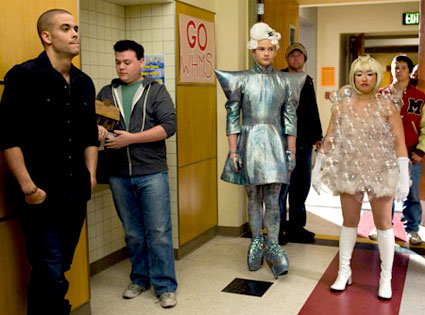
Sometimes cute. Often talented. And also quite often a piece of gooey, unkempt, poorly-defined messes.
I like Glee for some reasons, I really do. The cast is talented, there have been some stronger episodes (particularly toward the beginning of the first season), the musical numbers are usually quite entertaining, and lately when the show just gives in to its messes (i.e. Power of Madonna and last night's Brittany/Britney) it is quite enjoyable in that format. I mentioned earlier to a friend that if Glee just devolved into incoherent musical numbers (which, to an extent, it already does) I'd still watch it and truly enjoy it for the variety/cabaret like quality it could be and is best at.
There are also many problems with Glee. The writing is often weak, continuity is crap, the "realism" is pathetic, and the treatment of minorities often stumbles off the fine-line between embracing and exposing stereotypes, not to mention giving heavy-handed speeches hand-in-hand with satirical nonsense. It's these weaknesses that make me think Glee could be just as successful and twice as entertaining if it abandoned plot all together and just played with its cast of characters as is and ran it like the best, most epic variety show/cabaret. I've always wanted cabarets to make a comeback though...
Amongst my many issues with Glee, I'd probably say the biggest one right now has a name: Rachel.

Sure, many of the characters are mishandled, underused, overused, given too much credit for their lack of abilities (I'm looking at Finn's singing AND dancing), etc.... but Rachel really takes the cake for me.
The thing is, Lea Michele is undeniably talented. She's got a great voice. I'm not sure if it's my favorite voice, but it's definitely good. Clearly, it makes sense that Rachel is often the lead. She's assertive and talented. The problem? She's an unrestrained diva who never learns from her many mistakes. Rachel is not only annoying, she is often insufferable. All together, these two episodes in the second season, I think I may have liked her for all of about ten seconds, in the latest episode, when she tells Finn that she'll stop being controlling since she's discovered her own empowerment. AWESOME. GREAT. ...and then, she goes back to her crazy, dramatic ultimatums. And I think to myself, WHO DOES THIS? What kind of crazy pills is this girl on?
Rachel has no redeeming qualities. Her personality is horrible. She is controlling, obnoxious, rude, self-centered, and displays somewhat sociopath-like behavior (her "I'm doing this because I love you" shtick in the season opener, much?). Rachel also has an obsessive personality, which means when she gets on about something, she harps on about it incessantly, because she's also a loud-mouth. Sure, she "owns up" to her mistakes, sometimes, but then she goes and does another horrible thing next week. And whoops, again, and then another thing, and then she's got a clean-slate again. Seriously, I used to wonder what Rachel saw in Finn, but what the hell does Finn see in Rachel? She's pretty and talented, and that's about it.
And the show exploits this. The show is convinced that Rachel is our hero, that Rachel really does mean well, and that Rachel is worth loving despite her flaws... because why? Because she sings really, really well, and here, let's demonstrate by having her sing a big, dramatic number at the end of the episode (the modus operendi for this season thus far, and used a bit last season as well - Episodes 2, 17, and 18). We're led to believe that Rachel is redeemed because she sings a heartfelt song, but she still resorted to crazy-ass, selfish means to keep Sunshine out of the club, and she still gave Finn a crazy-ass, selfish ultimatum. I don't see how being talented makes up for being a shitty person.
Rachel is the center of Glee's problems for me, because Glee has disillusioned itself into seeing her as someone that she really does not come off as: a victim. In the first season, somewhat, when Finn was actively ditching her, I could see it, but now she's only a victim of her own behavior. Likewise, Glee has disillusioned itself into seeing its show as a well put-together, honest, real show, when it's really just a fun hot mess. The problem is that Glee has got an epic fanbase, a great appeal, lots of merchandising, and the ratings to keep going for years.
It reminds me of the second season of Heroes, however. I knew Heroes wasn't the strongest show, but I was in love with it anyways, in love with its possibilities and its conceits. Heroes too was a huge hit when it started, if anyone can remember that a few years back. But Heroes too lost itself in numerous characters, bad writing, weird plotting, and stock in unchanging characters (including, also, an unlikable heroine with Claire). Heroes fell off ratings-wise, however, killed by the writer's strike. Heroes also didn't have built-in merchandising. It was, however, also hailed for its originality. Heroes brought superheroes to network television, Glee brought the musical. Neither were first, exactly, but they were hailed as successes moreso than others, though. It seems odd, because Heroes and Glee are nothing alike in actual context, but I simply see a lot of similar problems. Glee is so in love with itself, so doting on its fanbase, and so inconsistent, doubting that it could ever go wrong. Maybe Glee will improve; I think it has the possibility, but I doubt it will.
I'll just keep on watching Glee until it's too much of a train wreck to stand anymore (give it another season). It's still enjoyable and has its moments, but I'm not recommending it to anyone anytime soon. I learned my lesson about corrupting my poor friends when Heroes was in a downfall. There I thought it would get better and was wrong. Maybe if I expect Glee to keep on descending in quality, it will actually get sharper.
And so ends my mega-long ramble on Glee. g'night folks. I'm off to watch No Ordinary Family! I also hope that is better than Heroes. >.>
Friday, August 27, 2010
The Heart of the Heist
I know this may be silly and I don't really feel like writing up a whole essay on why I feel this way, but of the many talented men of Inception that could possibly be noticed on a supporting actor level, my choice would be Cillian Murphy's Robert Fischer.
Granted, one hardly needs an Oscar nomination or win to be remembered and I won't be surprised in a few months when Inception will fail to put up any nominees in the supporting actor category (as it is, neither Leonardo DiCaprio for lead nor Marion Cotillard for supporting are anywhere near safe bets, but are likelier than anything else). I do believe, however, of all the interesting supporting actors featured within Inception, whenever Cillian Murphy was on screen, that's where my attention went, and it's not just because he's attractive, it's because he played the part so well and it really was a plum part amongst Ocean's Eleven type caricatures (which, though fun and well-performed and well-written, aren't exactly screaming emotional depth).
Whether or not he gets any awards attention, I simply wished to express the beautiful supporting performance Cillian Murphy put on for us all. He is quite a talented actor and I'll certainly be looking into more of his works thanks to a fantastic job in Inception.
And this is not a knock to any of the other supporting gents; you are all great. But, if I had to choose one, there's no real question about it. That scene in the third level of the dream, with his father, was nearly as touching to me as the entirety of Toy Story 3. Some might complain that Inception is heartless, but it's not, and Robert Fischer is that heart. You may say it does not count, because he is dreaming and asleep, but in the immortal words of Albus Dumbledore, "Of course this is happening inside your head, but why on earth should that mean it's not real?"
I've been quoting Harry Potter a lot lately. So shoot me.
Granted, one hardly needs an Oscar nomination or win to be remembered and I won't be surprised in a few months when Inception will fail to put up any nominees in the supporting actor category (as it is, neither Leonardo DiCaprio for lead nor Marion Cotillard for supporting are anywhere near safe bets, but are likelier than anything else). I do believe, however, of all the interesting supporting actors featured within Inception, whenever Cillian Murphy was on screen, that's where my attention went, and it's not just because he's attractive, it's because he played the part so well and it really was a plum part amongst Ocean's Eleven type caricatures (which, though fun and well-performed and well-written, aren't exactly screaming emotional depth).
Whether or not he gets any awards attention, I simply wished to express the beautiful supporting performance Cillian Murphy put on for us all. He is quite a talented actor and I'll certainly be looking into more of his works thanks to a fantastic job in Inception.
And this is not a knock to any of the other supporting gents; you are all great. But, if I had to choose one, there's no real question about it. That scene in the third level of the dream, with his father, was nearly as touching to me as the entirety of Toy Story 3. Some might complain that Inception is heartless, but it's not, and Robert Fischer is that heart. You may say it does not count, because he is dreaming and asleep, but in the immortal words of Albus Dumbledore, "Of course this is happening inside your head, but why on earth should that mean it's not real?"
I've been quoting Harry Potter a lot lately. So shoot me.
Saturday, August 21, 2010
Why I Watch The Human Target

I think I've discovered what it is that really draws me into The Human Target, and it's not just the really awesome action sequences and the slowly building mythology. I know there was a fair amount of sad faces over Chi McBride being somewhat underused thus far, but his partnership with Mark Valley's Christopher Chance reminds me very strongly of Jet and Spike from Cowboy Bebop, and the whole series at large is very reminiscent of that brilliant anime series (as someone who has never gotten into a single other anime series, I believe it's a sign of the quality of Cowboy Bebop that I love it so much).

Just look at those pictures and try to tell me how different those scenes are.
I don't know how influenced the current incarnation of Human Target is by the 1992 series, but I wouldn't be at all surprised if this relationship in Human Target was influenced by Jet and Spike from Cowboy Bebop rather than anything from there. As for the rest of the Bebop, Guerrero is obviously Ed and his flaky, casual attitude is very reminiscent of Ed's excellent craziness. The host of female figures that wander in and out of Human Target play the role of Faye (although I hear a permanent female lead is coming in next season and maybe we'll get a real Faye going on). But in the end, it all comes back to Chance and Winston.
I had a conversation with a friend of mine a few years ago about the Cowboy Bebop cast. He commented about how he thought Jet was a rather unnecessary character next to Spike, Faye, Ed, and Ein, who all had their own purposes. I defended Jet, because I really like Jet and he is really the unifying link. His partnership and friendship with Spike was what was at the beginning and it was what was at the end.
Jet and Winston have a lot of those stick-in-the-mud sidekick characteristics to Spike and Chance's more reckless attitudes - they both tend to chide the lead character a lot, do a fair amount of yelling and sighing and eye-rolling, and sit to the sidelines a fair amount of the time. On the other hand, of course, it's proven in both Winston and Jet's cases that they are capable of much ass-kicking. Their histories are similar, as they are both former cops, just like Spike and Chance are the same person for their shady histories (Spike being an ex-mobster and Chance being an ex-assassin). Layer on top of that the characters of Baptiste and Vicious and their former-friend/protege-turned-rival relationships with Chance and Spike and it's kind of hard to distinguish the differences between these two series. They also both alternate between mission-of-the-week/bounty-of-the-week and the overall mythology of the series. And, of course, the mysterious dead(?) dame - Victoria is Chance's Julia - a badass woman worth falling for.
Human Target and Cowboy Bebop have their differences too, of course, namely that the bounty hunters of Cowboy Bebop are mildly less successful than Winston, Chance, and Guerrero, but even then, both Spike and Chance are infamous for causing major, expensive damage in the line of duty. Bounty hunting is also much different than the work Chance does, of course, which is essentially the opposite of bounty hunting.
But besides the series' similarities and differences, the central relationship between the reckless lead and his more sobering partner is one of my favorite parts of Human Target which, to be quite honest, makes better use of this relationship than Cowboy Bebop (but then Cowboy Bebop's got Faye, whom I adore to bits and pieces and I love all of her scenes with Spike so freakin' much).
Human Target doesn't attract a huge audience, which isn't surprising but is still a bit of a disappointment. It follows the good television rule of half procedural and half mythology, allowing current fans to be pleased while not shutting out potential fans. I'm really pleased Human Target's got a second season at all, even if it is in the death slot of Friday. I'm really excited to see more of the adventures Chance, Winston, and Guerrero go on and see a hint more of the mythology. Of course, I doubt the show will last much longer, but I can live with that. After all, Cowboy Bebop only has 26 half-hour episodes and it's still brilliant.
Wednesday, August 18, 2010
Objectification of both genders versus the objectification of just women - more or less progressive?
Is the entertainment industry the only place where it's OK to objectify men and women?
The argument that, if Hollywood and the entertainment industry at large objectify women, this is okay would be that those in the industry put themselves out there for judgment - their entire lives are defined by the opinions of other people. Those opinions may center on their appearance, but actors are also admired for their talent, wit, personality, and poise. Actors (both male and female) are hired for many reasons and attractiveness is amongst these reasons.
This is, of course, something that would not stand in pretty much any other profession. But at the same time, I wonder, is the entertainment industry's objectification of both women AND men something that makes it more or less progressive than other industries?
Men, sit down and shut up because this is for the women. Honestly, when was the last time any man felt like they were being judged by their appearance for a job interview? I don't want to hear men complaining about being objectified or judged by their appearance because, believe me, women have it worse. Luckily, at the tender age of twenty, I haven't experienced a job interview where I've been judged based on my appearance, probably because my jobs have been mostly minimum wage based professions (i.e. cashier, hostess, tour guide). But that doesn't mean I haven't felt the brunt of judgment about my appearance.
Let me break it down for you. I've had big boobs since I was 12 years old and I'm a natural blonde. I'm also 5'3. How many people do you think look at me and take me seriously, especially since I have a goofy, outgoing personality and a liking for feminine clothing? Men, how many of you have felt the judging eyes because you're short or fat? I apologize to anybody who is a minority because I know that race is another huge judgment point for people.
But women have been objectified for ages. What's the image that comes to mind when you think stripper? It's always going to be a girl, a skimpily dressed young woman. Porn stars, sex tapes, anything raunchy, you're probably going to be thinking about girls.
Celebrities and others within the entertainment industry who aren't necessarily defined as celebrities, on the other hand, are judged for their appearance no matter which gender. It's easy to make the argument that judging someone based on their appearance is wrong no matter what and I don't disagree. On the other hand, it's foolish for anyone to go into the entertainment industry thinking that their appearance won't be a part of their image. Whether it's the typical actor, that wants to be recognized for his or her work within their films or television series or other projects, or the more celebrity-based actor whose personal life is the center of attention, it's all about the appearance. In the former case, how well does the appearance of the actor fit the role? That's why actors get a lot of cred when they shake things up majorly for a role, say, gain or lose a lot of weight or drastically change their appearance so as to be unrecognizable. In the latter case, it's still about appearance, but about the actual, natural appearance outside of the movies and videos. Either way, actors are putting out their entire selves to be judged, and that includes their appearance.
So is it really unfair to then go ahead and deem someone attractive or unattractive? More often, people deem those in the entertainment industry attractive. Nobody really writes posts or articles about how unattractive someone is, and I doubt you'll find any genuine, credible source talking about the attractiveness/unattractiveness of celebrities or actors in the first place, save if it's about a role transformation.
I understand the harm of basing opinions of someone solely on their appearance, I really do. Nobody wants to be seen as just a pretty face - actors want to be taken seriously as actors and though appearance is a part of that, it's the praise for the talent that matters more than the praise for the appearance. My counter-argument, however, is that there is a line between playful "s/he's so hot" and derogatory comments like "s/he's just a pretty face." Is it really so wrong to drool over a Google image search of certain actors, so long as they're acknowledged as something more?
Well, I'll bring it back to me because I'm a selfish ho and I know myself pretty well and can't speak for everyone else. I love getting compliments on my appearance. I love getting comments on my talent as a filmmaker/musician/good person more, but I would never begrudge someone for thinking me attractive, so long as they know there's more to me than that.
Back on the sexism track, sometimes it's tough for me to think that people actually do see more to me than blonde hair and a big rack. I don't know, but, men, do you have the same problem? Do you feel as if women look at you and they only see what you look like and could never see you as something more than a man?
Historically speaking, though I know men also face objectification, men have always been more than just their appearance though. Men have always held jobs or positions or some role in the public world. Women, on the other hands, have been defined for centuries based on our womanhood and nothing else, because we didn't work, we didn't hold positions - all we were good for was being a woman (which entails: looking pretty, having kids, being present, etc.).
Do I feel for actors who are judged entirely on their appearance, regardless of their gender? Yes, I do. However, I feel a lot more for the women, to this day, who suffer from their gender in the workplace. Nobody would dare to call a man who worked as an office manager "just a secretary" but they would dare to call my mother that because she's a woman - she, as a woman, is a secretary and any other title is a joke, whereas it would be an insult for a man to ignore his actual title. God, what is this, Mad Men?
It may not be entirely right to judge actors based on their appearances, but it is part of their job. It is in no way, shape, or form part of an office worker's job to be judged on their appearance (well, maybe outside of their outfit; I'd judge a dude who wore a scuba suit to work, because that's just inappropriate - there is a certain dress code to working in the professional world). And though this may sound cruel, at least the entertainment industry is a bit more fair, ogling both men and women as attractive. Women definitely have a tougher time and are more scrutinized, but at least it's a bit more fair than the rest of the world.
Just keep on the right side of the line and don't cross over to pure appearance judgment and I don't see what's so wrong about appreciating beauty. It's not everything, it shouldn't be everything, but an appreciation is acceptable. I appreciate Alexander Skarsgard, for instance, both as a very attractive man and as a fantastic actor in his current role as Eric Northman in True Blood. He embodies the wit, slyness, and power of Eric very well. But, at the same time, I very much like the way he looks. Am I wrong?
I'm sure some might think so, but whatever.
(Inspired in part by a conversation had with a chap in the comments section of this EW.com post.)
The argument that, if Hollywood and the entertainment industry at large objectify women, this is okay would be that those in the industry put themselves out there for judgment - their entire lives are defined by the opinions of other people. Those opinions may center on their appearance, but actors are also admired for their talent, wit, personality, and poise. Actors (both male and female) are hired for many reasons and attractiveness is amongst these reasons.
This is, of course, something that would not stand in pretty much any other profession. But at the same time, I wonder, is the entertainment industry's objectification of both women AND men something that makes it more or less progressive than other industries?
Men, sit down and shut up because this is for the women. Honestly, when was the last time any man felt like they were being judged by their appearance for a job interview? I don't want to hear men complaining about being objectified or judged by their appearance because, believe me, women have it worse. Luckily, at the tender age of twenty, I haven't experienced a job interview where I've been judged based on my appearance, probably because my jobs have been mostly minimum wage based professions (i.e. cashier, hostess, tour guide). But that doesn't mean I haven't felt the brunt of judgment about my appearance.
Let me break it down for you. I've had big boobs since I was 12 years old and I'm a natural blonde. I'm also 5'3. How many people do you think look at me and take me seriously, especially since I have a goofy, outgoing personality and a liking for feminine clothing? Men, how many of you have felt the judging eyes because you're short or fat? I apologize to anybody who is a minority because I know that race is another huge judgment point for people.
But women have been objectified for ages. What's the image that comes to mind when you think stripper? It's always going to be a girl, a skimpily dressed young woman. Porn stars, sex tapes, anything raunchy, you're probably going to be thinking about girls.
Celebrities and others within the entertainment industry who aren't necessarily defined as celebrities, on the other hand, are judged for their appearance no matter which gender. It's easy to make the argument that judging someone based on their appearance is wrong no matter what and I don't disagree. On the other hand, it's foolish for anyone to go into the entertainment industry thinking that their appearance won't be a part of their image. Whether it's the typical actor, that wants to be recognized for his or her work within their films or television series or other projects, or the more celebrity-based actor whose personal life is the center of attention, it's all about the appearance. In the former case, how well does the appearance of the actor fit the role? That's why actors get a lot of cred when they shake things up majorly for a role, say, gain or lose a lot of weight or drastically change their appearance so as to be unrecognizable. In the latter case, it's still about appearance, but about the actual, natural appearance outside of the movies and videos. Either way, actors are putting out their entire selves to be judged, and that includes their appearance.
So is it really unfair to then go ahead and deem someone attractive or unattractive? More often, people deem those in the entertainment industry attractive. Nobody really writes posts or articles about how unattractive someone is, and I doubt you'll find any genuine, credible source talking about the attractiveness/unattractiveness of celebrities or actors in the first place, save if it's about a role transformation.
I understand the harm of basing opinions of someone solely on their appearance, I really do. Nobody wants to be seen as just a pretty face - actors want to be taken seriously as actors and though appearance is a part of that, it's the praise for the talent that matters more than the praise for the appearance. My counter-argument, however, is that there is a line between playful "s/he's so hot" and derogatory comments like "s/he's just a pretty face." Is it really so wrong to drool over a Google image search of certain actors, so long as they're acknowledged as something more?
Well, I'll bring it back to me because I'm a selfish ho and I know myself pretty well and can't speak for everyone else. I love getting compliments on my appearance. I love getting comments on my talent as a filmmaker/musician/good person more, but I would never begrudge someone for thinking me attractive, so long as they know there's more to me than that.
Back on the sexism track, sometimes it's tough for me to think that people actually do see more to me than blonde hair and a big rack. I don't know, but, men, do you have the same problem? Do you feel as if women look at you and they only see what you look like and could never see you as something more than a man?
Historically speaking, though I know men also face objectification, men have always been more than just their appearance though. Men have always held jobs or positions or some role in the public world. Women, on the other hands, have been defined for centuries based on our womanhood and nothing else, because we didn't work, we didn't hold positions - all we were good for was being a woman (which entails: looking pretty, having kids, being present, etc.).
Do I feel for actors who are judged entirely on their appearance, regardless of their gender? Yes, I do. However, I feel a lot more for the women, to this day, who suffer from their gender in the workplace. Nobody would dare to call a man who worked as an office manager "just a secretary" but they would dare to call my mother that because she's a woman - she, as a woman, is a secretary and any other title is a joke, whereas it would be an insult for a man to ignore his actual title. God, what is this, Mad Men?
It may not be entirely right to judge actors based on their appearances, but it is part of their job. It is in no way, shape, or form part of an office worker's job to be judged on their appearance (well, maybe outside of their outfit; I'd judge a dude who wore a scuba suit to work, because that's just inappropriate - there is a certain dress code to working in the professional world). And though this may sound cruel, at least the entertainment industry is a bit more fair, ogling both men and women as attractive. Women definitely have a tougher time and are more scrutinized, but at least it's a bit more fair than the rest of the world.
Just keep on the right side of the line and don't cross over to pure appearance judgment and I don't see what's so wrong about appreciating beauty. It's not everything, it shouldn't be everything, but an appreciation is acceptable. I appreciate Alexander Skarsgard, for instance, both as a very attractive man and as a fantastic actor in his current role as Eric Northman in True Blood. He embodies the wit, slyness, and power of Eric very well. But, at the same time, I very much like the way he looks. Am I wrong?
I'm sure some might think so, but whatever.
(Inspired in part by a conversation had with a chap in the comments section of this EW.com post.)
Subscribe to:
Posts (Atom)