So normally I don't post personal stuff here that's too distant from pop culture or the entertainment industry or film or movies or whatever, but this is an identity thing and as someone who identifies herself by her relationship to the arts more than probably anything else, I thought this wouldn't be too out of place. It's a letter/essay I wrote on the War Against Women happening right now in the dear ol' U.S. of A. and you can find it here on tumblr: http://jackrosejackrose.tumblr.com/post/19470050879/the-war-on-womens-identities
Enjoy, I hope. Critique or share if you like.
Showing posts with label rant-o-mania. Show all posts
Showing posts with label rant-o-mania. Show all posts
Saturday, March 17, 2012

Monday, May 16, 2011
The Problem With Jennifer's Body
Please wake me up in about two years, so that The Hunger Games movie has come out and the fandom has had enough time to make their way through all the usual complaints a fandom undergoes when their beloved source material is changed on its way to the screen and I can talk with people again about the actual content of the story as opposed to whether or not every single person cast looks right for the role. And by looks right, not, I don't mean is made to look right via training and make-up and costume. I mean bitching about how a young actress actually has meat on her bones and is thus an inappropriate choice despite what the author and director say.
Despite being a bit above the target age range for Suzanne Collins' The Hunger Games trilogy, about a month and a half ago I decided to give it a spur of the moment read and I admit I was instantly addicted. It's an engrossing story with what I think are generally interesting characters and pretty decent writing. I will happily discuss whether the love triangle is annoyingly overplayed in Catching Fire, whether Katniss' behaviour in Mockingjay is either due to proper characterization or author laziness, and whether the ending is sufficient or not.
What I cannot stand, however, are the same debates I participated in, intensely, mind you, once upon a time when I was a thirteen-year-old crazed and newly indoctrinated Harry Potter fan. Was I pissed that Daniel Radcliffe had blue eyes and not green and found it silly he wasn't wearing contacts to fix that? You bet. When I was older and I realized that a) such an obsession was stupid, b) that it really didn't matter that much, and c) that Daniel Radcliffe was unable to wear the contacts because of irritation, I got over it. I think most fans did eventually because we realized what a stupid little debate it was. Harry's blazing green eyes, like his mother's, are a huge deal in the books. In the movies, they're less so. They're still a deal - Lupin remarks on them particularly in the third film and I imagine they'll play their related role in the final film - but the films adjust for the problems faced.
These sorts of issues, as The Hunger Games movie inches slowly towards filming and, eventually, completion, are floating around the fandom in abundance. People are bitching about everything, and while Willow Shields' unibrow was a big hot topic, the biggest hot topic of all is the casting of Jennifer Lawrence as the beloved lead character of Katniss Everdeen. Now, I think Jennifer Lawrence is a great actress and I can completely see her personifying what I think is a strong female protagonist in Katniss. She probably doesn't look anything like I originally imagined Katniss to look like, but I can see it in her, just like I started to see Peeta in Josh Hutcherson, who also looks differently than one might have imagined Peeta (and don't get me started on the fans who are still obsessed with picking naturally blonde actors who are rather stringy in my opinion). Some people, however, are far too obsessed with the appearance, particularly parts of Jennifer Lawrence's appearance that are harder to fix than her hair color - and I'm not talking about the debate raging over Katniss' skin color, I'm talking about her weight.
The objections to Jennifer Lawrence's curves, to put it bluntly, piss me the fuck off. It rings in my ears of all the horrendous standards that we hold women up to and the ways in which women are still objectified so much in film as having to be whatever image we deem correct and if it doesn't fit with our mold, then it is wrong. I know that when most people comment on Jennifer Lawrence's curves, they don't mean that actresses can't be curvy. Of course not, we have Queen Latifah, known for her bodacious body. But this is really not the norm. We have such bizarre and unrealistic and every-changing standards for women and we never seem to be able to do it right. As Jennifer Hudson has lost weight, many of her fans have been rather shocked and disappointed that she felt the need to lose weight, while simultaneously people are constantly wondering if Gabourey Sidibe should lose some weight because she might be dangerously unhealthy. Don't get me wrong, I do think obesity is a problem in this country and not one we should glorify. But neither should we glorify appearances that are unattainable or at the very least extremely difficult for normal women to attain. While we encourage girls to embrace their curves, we continue to bash women whose weight changes regularly, like Kelly Clarkson. When Lady Gaga puts on a few pounds, suddenly her stomach becomes a huge national problem - Why isn't she as skinny as she was in the Telephone music video!?!?!? we wonder, because it's wrong for these women who are supposed to be visually perfect to ruin our images of them by being human. Weight fluctuation is hardly unheard of amongst the normal folk and beneath the personal trainers and strict diets, celebrities are normal folk too.
That said, then, shouldn't we choose actors who can physically embody the very specific framework we have in mind for a character? Dumb, dumb, dumb. I get it, Katniss' character is very specifically one who has suffered from malnourishment her entire life. But even if we get a sickly stick of an actress who could potentially perform the role of Katniss brilliantly, there's still a difference between a healthy, skinny body and a malnourished, skinny body. And let's face it, we're not going to cast someone that is literally malnourished - that is, unless Christian Bale was in the role and he would just make that choice on his own probably and the fans would hail him for it, but would it be right? Everyone also worries when Christian Bale does such a thing, and we'd worry for whatever actress that played Katniss that would do it too. But, BUT, beneath that worry, don't even lie to yourself, you'd be proud of that actor for taking such a dramatic step. You'd be impressed and pleased that the actor would be willing to take such a risk for the sake of art. I'm not going to lie, I'd probably be impressed too. But while being impressed, I'd also be disgusted.
There is a poster that hangs in the health services office in my college. It shows two pictures of legs. One is a starving child. One is a runway model. Their legs, despite one pair being cleaner than the other, are indistinguishably similar in shape. That horrifies me, which is the point of the poster. If you are naturally skinny, there's nothing you can help about that. Same with if you're curvy. But there is still, always, a difference between what is natural and healthy and what is unnatural and unhealthy. You can suffer from either no matter what shape or size you are.
We need to stop boxing women into categories based on their size though. Daniel Radcliffe has grown up to be a lot stockier than I imagined Harry in the books to be - Harry always seemed so stretched and, at times, lanky. Daniel Radcliffe is of more average height and weight in appearance. But he has also grown into becoming a better actor and a better Harry over the years. Movie!Harry and Book!Harry are different in their appearance and y'know what? That's okay, because Daniel Radcliffe still manages to capture the general essence of what the character of Harry Potter is, at least in the movies. A smaller debate has raged in the Potter fandom community over the looks of its female characters. In the books, Ginny is supposed to be very popular and supposedly pretty good-looking, but Bonnie Wright's beauty doesn't seem to be particularly played up in the movies making her a bit more plain. Alternatively, in the books, Hermione is generally pretty average looking from the perspective and her hair frizzy, but by the third movie, Emma Watson was clearly turning into a pretty young woman and her hair was no longer made to look quite so frizzy. I have long contended, particularly in Hermione's case, that these are just examples of how different the book and movie versions of the characters are. And THAT'S OKAY.
Why is that okay? First of all, when it comes to movie adaptations of books, I tend to believe that the best adaptations are more interpretations. Good adaptations should be done by fans of the original source material, but intelligent fans who have enough distance from the source material to be able to know what the story is about without obsessing too much on details that may be less important. My favorite example of an adaptation is Lord of the Rings. I love the books and the movies, but though they capture a similar plotline and a similar essence, they are truly different stories, but they are both grand and know what story they want to tell. My main problem with, say, the Harry Potter movie adaptations is that they're a bit scatter-brained, not just because of the different directors, but also because most of the earlier films didn't give strong enough hints of what this story was supposed to be about. I have no expectation that The Hunger Games movie will be just like the book, and I really hope it isn't. I want to watch something that takes the plot and the morals and the characters and shape them ever so slightly different to fit the very different medium that film is from novels. I want the actors to be good and the script to be strong and the effects to be well-done and all the elements of filmmaking to be well-executed, and if it isn't the same as the book, so long as it's well-made, I am totally okay with that.
Secondly, reality is not so easy to manipulate as the written world of a book and whatever live-action movies are, they are capturing something that was physically there, in reality, at some point (not counting CGI). Reality can be manipulated, but in a different way, for different reasons.
Finally, I want to break out of the boxes we have created for women. Katniss can still be Katniss even if her ribs aren't frighteningly protruding. I cannot accept the fact that women have to be defined by their appearance, that Katniss can only be a skinny girl, for instance. Stanley Tucci is a pretty fit individual, small and seemingly average in his weight and yet isn't Caesar Flickerman supposed to be rather rotund? I have not heard a single person complain that his stomach isn't the right size for the role. You may argue that that isn't the same, it doesn't define Caesar like it does Katniss, but Katniss is defined by much, MUCH more than her weight. If all Katniss was was a malnourished girl, she wouldn't be the strong character I believe her to be. Women's appearances are a part of who we are, certainly, but there is so much more that goes into defining ourselves, just like men, that I really wish we could stop placing more value on a woman's appearance than her other features. "The Girl Next Door" is more of a look than a personality type. "The Blonde Bombshell." "The Femme Fatale." These types and the many others women exemplify are so defined by appearance in our minds rather than attitude, and most of the categories really are about the attitude.
So, in conclusion, either the entire world needs to change or I really need to learn how to bite my tongue. Well, I've already got a scar from biting through my tongue a lot as a kid, I might as well keep up the hard work.
Despite being a bit above the target age range for Suzanne Collins' The Hunger Games trilogy, about a month and a half ago I decided to give it a spur of the moment read and I admit I was instantly addicted. It's an engrossing story with what I think are generally interesting characters and pretty decent writing. I will happily discuss whether the love triangle is annoyingly overplayed in Catching Fire, whether Katniss' behaviour in Mockingjay is either due to proper characterization or author laziness, and whether the ending is sufficient or not.
What I cannot stand, however, are the same debates I participated in, intensely, mind you, once upon a time when I was a thirteen-year-old crazed and newly indoctrinated Harry Potter fan. Was I pissed that Daniel Radcliffe had blue eyes and not green and found it silly he wasn't wearing contacts to fix that? You bet. When I was older and I realized that a) such an obsession was stupid, b) that it really didn't matter that much, and c) that Daniel Radcliffe was unable to wear the contacts because of irritation, I got over it. I think most fans did eventually because we realized what a stupid little debate it was. Harry's blazing green eyes, like his mother's, are a huge deal in the books. In the movies, they're less so. They're still a deal - Lupin remarks on them particularly in the third film and I imagine they'll play their related role in the final film - but the films adjust for the problems faced.
These sorts of issues, as The Hunger Games movie inches slowly towards filming and, eventually, completion, are floating around the fandom in abundance. People are bitching about everything, and while Willow Shields' unibrow was a big hot topic, the biggest hot topic of all is the casting of Jennifer Lawrence as the beloved lead character of Katniss Everdeen. Now, I think Jennifer Lawrence is a great actress and I can completely see her personifying what I think is a strong female protagonist in Katniss. She probably doesn't look anything like I originally imagined Katniss to look like, but I can see it in her, just like I started to see Peeta in Josh Hutcherson, who also looks differently than one might have imagined Peeta (and don't get me started on the fans who are still obsessed with picking naturally blonde actors who are rather stringy in my opinion). Some people, however, are far too obsessed with the appearance, particularly parts of Jennifer Lawrence's appearance that are harder to fix than her hair color - and I'm not talking about the debate raging over Katniss' skin color, I'm talking about her weight.
The objections to Jennifer Lawrence's curves, to put it bluntly, piss me the fuck off. It rings in my ears of all the horrendous standards that we hold women up to and the ways in which women are still objectified so much in film as having to be whatever image we deem correct and if it doesn't fit with our mold, then it is wrong. I know that when most people comment on Jennifer Lawrence's curves, they don't mean that actresses can't be curvy. Of course not, we have Queen Latifah, known for her bodacious body. But this is really not the norm. We have such bizarre and unrealistic and every-changing standards for women and we never seem to be able to do it right. As Jennifer Hudson has lost weight, many of her fans have been rather shocked and disappointed that she felt the need to lose weight, while simultaneously people are constantly wondering if Gabourey Sidibe should lose some weight because she might be dangerously unhealthy. Don't get me wrong, I do think obesity is a problem in this country and not one we should glorify. But neither should we glorify appearances that are unattainable or at the very least extremely difficult for normal women to attain. While we encourage girls to embrace their curves, we continue to bash women whose weight changes regularly, like Kelly Clarkson. When Lady Gaga puts on a few pounds, suddenly her stomach becomes a huge national problem - Why isn't she as skinny as she was in the Telephone music video!?!?!? we wonder, because it's wrong for these women who are supposed to be visually perfect to ruin our images of them by being human. Weight fluctuation is hardly unheard of amongst the normal folk and beneath the personal trainers and strict diets, celebrities are normal folk too.
That said, then, shouldn't we choose actors who can physically embody the very specific framework we have in mind for a character? Dumb, dumb, dumb. I get it, Katniss' character is very specifically one who has suffered from malnourishment her entire life. But even if we get a sickly stick of an actress who could potentially perform the role of Katniss brilliantly, there's still a difference between a healthy, skinny body and a malnourished, skinny body. And let's face it, we're not going to cast someone that is literally malnourished - that is, unless Christian Bale was in the role and he would just make that choice on his own probably and the fans would hail him for it, but would it be right? Everyone also worries when Christian Bale does such a thing, and we'd worry for whatever actress that played Katniss that would do it too. But, BUT, beneath that worry, don't even lie to yourself, you'd be proud of that actor for taking such a dramatic step. You'd be impressed and pleased that the actor would be willing to take such a risk for the sake of art. I'm not going to lie, I'd probably be impressed too. But while being impressed, I'd also be disgusted.
There is a poster that hangs in the health services office in my college. It shows two pictures of legs. One is a starving child. One is a runway model. Their legs, despite one pair being cleaner than the other, are indistinguishably similar in shape. That horrifies me, which is the point of the poster. If you are naturally skinny, there's nothing you can help about that. Same with if you're curvy. But there is still, always, a difference between what is natural and healthy and what is unnatural and unhealthy. You can suffer from either no matter what shape or size you are.
We need to stop boxing women into categories based on their size though. Daniel Radcliffe has grown up to be a lot stockier than I imagined Harry in the books to be - Harry always seemed so stretched and, at times, lanky. Daniel Radcliffe is of more average height and weight in appearance. But he has also grown into becoming a better actor and a better Harry over the years. Movie!Harry and Book!Harry are different in their appearance and y'know what? That's okay, because Daniel Radcliffe still manages to capture the general essence of what the character of Harry Potter is, at least in the movies. A smaller debate has raged in the Potter fandom community over the looks of its female characters. In the books, Ginny is supposed to be very popular and supposedly pretty good-looking, but Bonnie Wright's beauty doesn't seem to be particularly played up in the movies making her a bit more plain. Alternatively, in the books, Hermione is generally pretty average looking from the perspective and her hair frizzy, but by the third movie, Emma Watson was clearly turning into a pretty young woman and her hair was no longer made to look quite so frizzy. I have long contended, particularly in Hermione's case, that these are just examples of how different the book and movie versions of the characters are. And THAT'S OKAY.
Why is that okay? First of all, when it comes to movie adaptations of books, I tend to believe that the best adaptations are more interpretations. Good adaptations should be done by fans of the original source material, but intelligent fans who have enough distance from the source material to be able to know what the story is about without obsessing too much on details that may be less important. My favorite example of an adaptation is Lord of the Rings. I love the books and the movies, but though they capture a similar plotline and a similar essence, they are truly different stories, but they are both grand and know what story they want to tell. My main problem with, say, the Harry Potter movie adaptations is that they're a bit scatter-brained, not just because of the different directors, but also because most of the earlier films didn't give strong enough hints of what this story was supposed to be about. I have no expectation that The Hunger Games movie will be just like the book, and I really hope it isn't. I want to watch something that takes the plot and the morals and the characters and shape them ever so slightly different to fit the very different medium that film is from novels. I want the actors to be good and the script to be strong and the effects to be well-done and all the elements of filmmaking to be well-executed, and if it isn't the same as the book, so long as it's well-made, I am totally okay with that.
Secondly, reality is not so easy to manipulate as the written world of a book and whatever live-action movies are, they are capturing something that was physically there, in reality, at some point (not counting CGI). Reality can be manipulated, but in a different way, for different reasons.
Finally, I want to break out of the boxes we have created for women. Katniss can still be Katniss even if her ribs aren't frighteningly protruding. I cannot accept the fact that women have to be defined by their appearance, that Katniss can only be a skinny girl, for instance. Stanley Tucci is a pretty fit individual, small and seemingly average in his weight and yet isn't Caesar Flickerman supposed to be rather rotund? I have not heard a single person complain that his stomach isn't the right size for the role. You may argue that that isn't the same, it doesn't define Caesar like it does Katniss, but Katniss is defined by much, MUCH more than her weight. If all Katniss was was a malnourished girl, she wouldn't be the strong character I believe her to be. Women's appearances are a part of who we are, certainly, but there is so much more that goes into defining ourselves, just like men, that I really wish we could stop placing more value on a woman's appearance than her other features. "The Girl Next Door" is more of a look than a personality type. "The Blonde Bombshell." "The Femme Fatale." These types and the many others women exemplify are so defined by appearance in our minds rather than attitude, and most of the categories really are about the attitude.
So, in conclusion, either the entire world needs to change or I really need to learn how to bite my tongue. Well, I've already got a scar from biting through my tongue a lot as a kid, I might as well keep up the hard work.
Wednesday, September 29, 2010
Glee: The Rachel Problem & More
Been a little busy with the kick-off of the semester, but I'm going to try for a minor new blog post.
So. Glee.

Sometimes cute. Often talented. And also quite often a piece of gooey, unkempt, poorly-defined messes.
I like Glee for some reasons, I really do. The cast is talented, there have been some stronger episodes (particularly toward the beginning of the first season), the musical numbers are usually quite entertaining, and lately when the show just gives in to its messes (i.e. Power of Madonna and last night's Brittany/Britney) it is quite enjoyable in that format. I mentioned earlier to a friend that if Glee just devolved into incoherent musical numbers (which, to an extent, it already does) I'd still watch it and truly enjoy it for the variety/cabaret like quality it could be and is best at.
There are also many problems with Glee. The writing is often weak, continuity is crap, the "realism" is pathetic, and the treatment of minorities often stumbles off the fine-line between embracing and exposing stereotypes, not to mention giving heavy-handed speeches hand-in-hand with satirical nonsense. It's these weaknesses that make me think Glee could be just as successful and twice as entertaining if it abandoned plot all together and just played with its cast of characters as is and ran it like the best, most epic variety show/cabaret. I've always wanted cabarets to make a comeback though...
Amongst my many issues with Glee, I'd probably say the biggest one right now has a name: Rachel.

Sure, many of the characters are mishandled, underused, overused, given too much credit for their lack of abilities (I'm looking at Finn's singing AND dancing), etc.... but Rachel really takes the cake for me.
The thing is, Lea Michele is undeniably talented. She's got a great voice. I'm not sure if it's my favorite voice, but it's definitely good. Clearly, it makes sense that Rachel is often the lead. She's assertive and talented. The problem? She's an unrestrained diva who never learns from her many mistakes. Rachel is not only annoying, she is often insufferable. All together, these two episodes in the second season, I think I may have liked her for all of about ten seconds, in the latest episode, when she tells Finn that she'll stop being controlling since she's discovered her own empowerment. AWESOME. GREAT. ...and then, she goes back to her crazy, dramatic ultimatums. And I think to myself, WHO DOES THIS? What kind of crazy pills is this girl on?
Rachel has no redeeming qualities. Her personality is horrible. She is controlling, obnoxious, rude, self-centered, and displays somewhat sociopath-like behavior (her "I'm doing this because I love you" shtick in the season opener, much?). Rachel also has an obsessive personality, which means when she gets on about something, she harps on about it incessantly, because she's also a loud-mouth. Sure, she "owns up" to her mistakes, sometimes, but then she goes and does another horrible thing next week. And whoops, again, and then another thing, and then she's got a clean-slate again. Seriously, I used to wonder what Rachel saw in Finn, but what the hell does Finn see in Rachel? She's pretty and talented, and that's about it.
And the show exploits this. The show is convinced that Rachel is our hero, that Rachel really does mean well, and that Rachel is worth loving despite her flaws... because why? Because she sings really, really well, and here, let's demonstrate by having her sing a big, dramatic number at the end of the episode (the modus operendi for this season thus far, and used a bit last season as well - Episodes 2, 17, and 18). We're led to believe that Rachel is redeemed because she sings a heartfelt song, but she still resorted to crazy-ass, selfish means to keep Sunshine out of the club, and she still gave Finn a crazy-ass, selfish ultimatum. I don't see how being talented makes up for being a shitty person.
Rachel is the center of Glee's problems for me, because Glee has disillusioned itself into seeing her as someone that she really does not come off as: a victim. In the first season, somewhat, when Finn was actively ditching her, I could see it, but now she's only a victim of her own behavior. Likewise, Glee has disillusioned itself into seeing its show as a well put-together, honest, real show, when it's really just a fun hot mess. The problem is that Glee has got an epic fanbase, a great appeal, lots of merchandising, and the ratings to keep going for years.
It reminds me of the second season of Heroes, however. I knew Heroes wasn't the strongest show, but I was in love with it anyways, in love with its possibilities and its conceits. Heroes too was a huge hit when it started, if anyone can remember that a few years back. But Heroes too lost itself in numerous characters, bad writing, weird plotting, and stock in unchanging characters (including, also, an unlikable heroine with Claire). Heroes fell off ratings-wise, however, killed by the writer's strike. Heroes also didn't have built-in merchandising. It was, however, also hailed for its originality. Heroes brought superheroes to network television, Glee brought the musical. Neither were first, exactly, but they were hailed as successes moreso than others, though. It seems odd, because Heroes and Glee are nothing alike in actual context, but I simply see a lot of similar problems. Glee is so in love with itself, so doting on its fanbase, and so inconsistent, doubting that it could ever go wrong. Maybe Glee will improve; I think it has the possibility, but I doubt it will.
I'll just keep on watching Glee until it's too much of a train wreck to stand anymore (give it another season). It's still enjoyable and has its moments, but I'm not recommending it to anyone anytime soon. I learned my lesson about corrupting my poor friends when Heroes was in a downfall. There I thought it would get better and was wrong. Maybe if I expect Glee to keep on descending in quality, it will actually get sharper.
And so ends my mega-long ramble on Glee. g'night folks. I'm off to watch No Ordinary Family! I also hope that is better than Heroes. >.>
So. Glee.
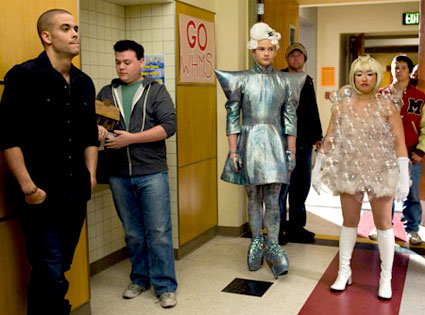
Sometimes cute. Often talented. And also quite often a piece of gooey, unkempt, poorly-defined messes.
I like Glee for some reasons, I really do. The cast is talented, there have been some stronger episodes (particularly toward the beginning of the first season), the musical numbers are usually quite entertaining, and lately when the show just gives in to its messes (i.e. Power of Madonna and last night's Brittany/Britney) it is quite enjoyable in that format. I mentioned earlier to a friend that if Glee just devolved into incoherent musical numbers (which, to an extent, it already does) I'd still watch it and truly enjoy it for the variety/cabaret like quality it could be and is best at.
There are also many problems with Glee. The writing is often weak, continuity is crap, the "realism" is pathetic, and the treatment of minorities often stumbles off the fine-line between embracing and exposing stereotypes, not to mention giving heavy-handed speeches hand-in-hand with satirical nonsense. It's these weaknesses that make me think Glee could be just as successful and twice as entertaining if it abandoned plot all together and just played with its cast of characters as is and ran it like the best, most epic variety show/cabaret. I've always wanted cabarets to make a comeback though...
Amongst my many issues with Glee, I'd probably say the biggest one right now has a name: Rachel.

Sure, many of the characters are mishandled, underused, overused, given too much credit for their lack of abilities (I'm looking at Finn's singing AND dancing), etc.... but Rachel really takes the cake for me.
The thing is, Lea Michele is undeniably talented. She's got a great voice. I'm not sure if it's my favorite voice, but it's definitely good. Clearly, it makes sense that Rachel is often the lead. She's assertive and talented. The problem? She's an unrestrained diva who never learns from her many mistakes. Rachel is not only annoying, she is often insufferable. All together, these two episodes in the second season, I think I may have liked her for all of about ten seconds, in the latest episode, when she tells Finn that she'll stop being controlling since she's discovered her own empowerment. AWESOME. GREAT. ...and then, she goes back to her crazy, dramatic ultimatums. And I think to myself, WHO DOES THIS? What kind of crazy pills is this girl on?
Rachel has no redeeming qualities. Her personality is horrible. She is controlling, obnoxious, rude, self-centered, and displays somewhat sociopath-like behavior (her "I'm doing this because I love you" shtick in the season opener, much?). Rachel also has an obsessive personality, which means when she gets on about something, she harps on about it incessantly, because she's also a loud-mouth. Sure, she "owns up" to her mistakes, sometimes, but then she goes and does another horrible thing next week. And whoops, again, and then another thing, and then she's got a clean-slate again. Seriously, I used to wonder what Rachel saw in Finn, but what the hell does Finn see in Rachel? She's pretty and talented, and that's about it.
And the show exploits this. The show is convinced that Rachel is our hero, that Rachel really does mean well, and that Rachel is worth loving despite her flaws... because why? Because she sings really, really well, and here, let's demonstrate by having her sing a big, dramatic number at the end of the episode (the modus operendi for this season thus far, and used a bit last season as well - Episodes 2, 17, and 18). We're led to believe that Rachel is redeemed because she sings a heartfelt song, but she still resorted to crazy-ass, selfish means to keep Sunshine out of the club, and she still gave Finn a crazy-ass, selfish ultimatum. I don't see how being talented makes up for being a shitty person.
Rachel is the center of Glee's problems for me, because Glee has disillusioned itself into seeing her as someone that she really does not come off as: a victim. In the first season, somewhat, when Finn was actively ditching her, I could see it, but now she's only a victim of her own behavior. Likewise, Glee has disillusioned itself into seeing its show as a well put-together, honest, real show, when it's really just a fun hot mess. The problem is that Glee has got an epic fanbase, a great appeal, lots of merchandising, and the ratings to keep going for years.
It reminds me of the second season of Heroes, however. I knew Heroes wasn't the strongest show, but I was in love with it anyways, in love with its possibilities and its conceits. Heroes too was a huge hit when it started, if anyone can remember that a few years back. But Heroes too lost itself in numerous characters, bad writing, weird plotting, and stock in unchanging characters (including, also, an unlikable heroine with Claire). Heroes fell off ratings-wise, however, killed by the writer's strike. Heroes also didn't have built-in merchandising. It was, however, also hailed for its originality. Heroes brought superheroes to network television, Glee brought the musical. Neither were first, exactly, but they were hailed as successes moreso than others, though. It seems odd, because Heroes and Glee are nothing alike in actual context, but I simply see a lot of similar problems. Glee is so in love with itself, so doting on its fanbase, and so inconsistent, doubting that it could ever go wrong. Maybe Glee will improve; I think it has the possibility, but I doubt it will.
I'll just keep on watching Glee until it's too much of a train wreck to stand anymore (give it another season). It's still enjoyable and has its moments, but I'm not recommending it to anyone anytime soon. I learned my lesson about corrupting my poor friends when Heroes was in a downfall. There I thought it would get better and was wrong. Maybe if I expect Glee to keep on descending in quality, it will actually get sharper.
And so ends my mega-long ramble on Glee. g'night folks. I'm off to watch No Ordinary Family! I also hope that is better than Heroes. >.>
Friday, July 2, 2010
Yet Another Reason I Hate Twilight... and some gender ranting
'scuse me that I'm bringing this up, but there's something interesting that was touched on in this article over on Entertainment Weekly that I addressed in the comments but felt was really worth sharing.
The quote that bothered me most?
“A grand paradox in all this is that a great many professed Twilight haters are young men who, though they may not acknowledge it, are threatened by this pop-cultural juggernaut.”
My response?
"To be quite fair, I am the exact demographic, a young woman, that Twilight is aimed at and I know plenty of young women just like me who are professed Twilight-haters. Sure, I believe that there are plenty of young men who hate Twilight, I know quite a few myself, but for young women like me, it’s hard not to be insulted by the creation of these books and their aim at people like me. The belief that I am a sucker for anything dazzling romantic just because I’m a young woman? Insulting. I mean, I can stomach some rom coms every now and then and sometimes I even actively seek them out, but story still matters, even then. Just like how I can’t stand a shrill heroine (a la Katherine Heigl in Knocked Up – TBH that girl has every right to trash that role), I can’t stand a, not only passive, but downright inconsiderate and selfish heroine like Bella. Why would I ever want to watch or read about a girl who is supposed to be like me, but doesn’t appreciate anything in her life despite parents and friends who care about her? I would never want to be like Bella, and I think it is incredibly insulting that people think I should want to be like her just because I am a young woman."
All in all, women have more of a reason to be Twilight haters than men.
Men have plenty of their own say in pop culture - people make the argument that it's all them for the superhero movies, for things like Transformers and James Bond flicks or things like Star Wars or Star Trek. To be quite honest, that's a stupid, sexist stereotype as I am hardly a tomboy (love me some stilettos and skirts) but I have seen at least one movie in each of the aforementioned franchises and enjoyed them immensely. My favorite effing movie is probably Star Wars. But regardless, if the argument is that men are jealous of Twilight hogging some spotlight in pop culture, I think it is an immensely weak argument. If men were supposed to be the sexist stereotypes people write them out to be, they'd probably be thrilled that women were drawn into something so bad rather than going to the movies for incredibly intelligent fare which would show them as a true threat.
Of course, this is all complete bullshit. Sure, there are sexist stereotyped men out there, but it's unfair to say the whole gender is that way, just as it is equally unfair to say that women love Twilight.
It is because of this second assumption - that young women should be very interested in the Twilight franchise according to market research or whatever - that is the reason I think many a woman hates Twilight. We are insulted by these assumptions about ourselves and what kinds of stories we like. I think men should be just as insulted when things like "men have to love Transformers 2 even if it sucks, but because things blow up" pop into the conversation.
All in all, trying to figure out the success or failure of a franchise still, unfortunately, comes down to this sexist crap. Women movie-goers fit into one category, men movie-goers into another. When an audience is over 70% one gender, CLEARLY the movie is made for that gender. But 30% of the other gender is nothing to sniff at. And it's rare that you hear such a huge percentage for one gender. Most of the time, I see the range is usually smaller, the difference usually less than 30%. It's sometimes a big gap, but I doubt there's a single movie that has never drawn both genders for whatever reason.
Women and men both like crappy movies. Women and men both like good movies. Women and men hate the same movies. Women and men hate different movies. For every girl who says a war movie is too bloody for her, you get a girl like me who adores a good war movie, no matter how bloody it is. For every guy who complains about chick flicks, you get a guy who can actually enjoy a clever enough chick flick.
I know marketers have a job to do when they're selling a movie, and they're trying to find the right demographic. I understand that, but stop boxing us up too. Just because Twilight draws a female-heavy box office doesn't make "women between the ages of 18-34 love Twilight" accurate because I am in that demographic and I can't stand that crap. You're just making me hate it more by assuming I like it.
The quote that bothered me most?
“A grand paradox in all this is that a great many professed Twilight haters are young men who, though they may not acknowledge it, are threatened by this pop-cultural juggernaut.”
My response?
"To be quite fair, I am the exact demographic, a young woman, that Twilight is aimed at and I know plenty of young women just like me who are professed Twilight-haters. Sure, I believe that there are plenty of young men who hate Twilight, I know quite a few myself, but for young women like me, it’s hard not to be insulted by the creation of these books and their aim at people like me. The belief that I am a sucker for anything dazzling romantic just because I’m a young woman? Insulting. I mean, I can stomach some rom coms every now and then and sometimes I even actively seek them out, but story still matters, even then. Just like how I can’t stand a shrill heroine (a la Katherine Heigl in Knocked Up – TBH that girl has every right to trash that role), I can’t stand a, not only passive, but downright inconsiderate and selfish heroine like Bella. Why would I ever want to watch or read about a girl who is supposed to be like me, but doesn’t appreciate anything in her life despite parents and friends who care about her? I would never want to be like Bella, and I think it is incredibly insulting that people think I should want to be like her just because I am a young woman."
All in all, women have more of a reason to be Twilight haters than men.
Men have plenty of their own say in pop culture - people make the argument that it's all them for the superhero movies, for things like Transformers and James Bond flicks or things like Star Wars or Star Trek. To be quite honest, that's a stupid, sexist stereotype as I am hardly a tomboy (love me some stilettos and skirts) but I have seen at least one movie in each of the aforementioned franchises and enjoyed them immensely. My favorite effing movie is probably Star Wars. But regardless, if the argument is that men are jealous of Twilight hogging some spotlight in pop culture, I think it is an immensely weak argument. If men were supposed to be the sexist stereotypes people write them out to be, they'd probably be thrilled that women were drawn into something so bad rather than going to the movies for incredibly intelligent fare which would show them as a true threat.
Of course, this is all complete bullshit. Sure, there are sexist stereotyped men out there, but it's unfair to say the whole gender is that way, just as it is equally unfair to say that women love Twilight.
It is because of this second assumption - that young women should be very interested in the Twilight franchise according to market research or whatever - that is the reason I think many a woman hates Twilight. We are insulted by these assumptions about ourselves and what kinds of stories we like. I think men should be just as insulted when things like "men have to love Transformers 2 even if it sucks, but because things blow up" pop into the conversation.
All in all, trying to figure out the success or failure of a franchise still, unfortunately, comes down to this sexist crap. Women movie-goers fit into one category, men movie-goers into another. When an audience is over 70% one gender, CLEARLY the movie is made for that gender. But 30% of the other gender is nothing to sniff at. And it's rare that you hear such a huge percentage for one gender. Most of the time, I see the range is usually smaller, the difference usually less than 30%. It's sometimes a big gap, but I doubt there's a single movie that has never drawn both genders for whatever reason.
Women and men both like crappy movies. Women and men both like good movies. Women and men hate the same movies. Women and men hate different movies. For every girl who says a war movie is too bloody for her, you get a girl like me who adores a good war movie, no matter how bloody it is. For every guy who complains about chick flicks, you get a guy who can actually enjoy a clever enough chick flick.
I know marketers have a job to do when they're selling a movie, and they're trying to find the right demographic. I understand that, but stop boxing us up too. Just because Twilight draws a female-heavy box office doesn't make "women between the ages of 18-34 love Twilight" accurate because I am in that demographic and I can't stand that crap. You're just making me hate it more by assuming I like it.
Saturday, June 19, 2010
Ego: Anton Ego and yours.
When I think about which Pixar movie is my favourite - and believe me, as a clear lover of everything Pixar, I think about this often enough - Ratatouille usually isn't at the top of my list (though it is never at the bottom). But that isn't because I don't love it - I truly do. Ratatouille was a grand experience - my first real foray into appreciating animated "kids" movies as, well, not an adult, but a seventeen-year-old, who might normally think they're too good for an animated movie and fully capable of seeing every movie at that age (three years later, I still get thrown off when I get carded 'cause I'm just so used to seeing everything regardless of rating, something my thirteen-year-old self would be jealous of). I'd seen most of the other Pixar movies, I'd lived through the Disney renaissance, but not like this.
The main thing I take away from Ratatouille is not the beautiful main message of the film, the one whose slogan rings throughout - "anyone can cook" - and translates into a tale of rising above one's circumstances based on talent and drive. The most beautiful and meaningful message any film has given me is also the most grounding of them - Anton Ego's stunning review of his meal at Remy's hands.
"In many ways, the work of a critic is easy. We risk very little yet enjoy a position over those who offer up their work and their selves to our judgment. We thrive on negative criticism, which is fun to write and to read. But the bitter truth we critics must face, is that in the grand scheme of things, the average piece of junk is probably more meaningful than our criticism designating it so. But there are times when a critic truly risks something, and that is in the discovery and defense of the new. The world is often unkind to new talent, new creations, the new needs friends. Last night, I experienced something new, an extraordinary meal from a singularly unexpected source. To say that both the meal and its maker have challenged my preconceptions about fine cooking is a gross understatement. They have rocked me to my core. In the past, I have made no secret of my disdain for Chef Gusteau's famous motto: Anyone can cook. But I realize, only now do I truly understand what he meant. Not everyone can become a great artist, but a great artist can come from anywhere. It is difficult to imagine more humble origins than those of the genius now cooking at Gusteau's, who is, in this critic's opinion, nothing less than the finest chef in France. I will be returning to Gusteau's soon, hungry for more."
One reason I admire film critics and all people who love film is how they love finding something new to share with everyone else. It's such a pleasure to ask a friend, "have you seen ___?" and to hear them reply in the negative. Then, you are granted the opportunity to open their eyes to that world.
But it is that same admirable quality that I also can't stand in film critics, people who love films, and oftentimes even in myself. Because, as much as I love film myself, most people do not care nearly as much as people like me and people who dedicate themselves to a life of loving, understanding, and analyzing film.
We all have different opinions. Like everyone else, I fall prey to being upset when someone disagrees with something I feel so strongly about - people who refuse to see Star Wars or people who avoid animated movies because they're "for kids" or people who are too stuck up to appreciate the badassery of Death Race or people who are too bored with film to listen to my recommendations. But all of those people exist and I'd be a fool to hate all of them for those reasons. I love film, but people who only like it or don't like it at all are not any worse or better than me by that mere characteristic.
Ego's speech from Ratatouille, particularly the first few sentences, often give me the swift kick in the rear I think everyone involved in film (other fields too, I'm sure, but the entertainment and art fields in particular fall prey to this most, I feel) really needs. We all need a reminder that our opinions, what we say and what we write and all the time and energy we dedicate to our field isn't the be all and end all. So many people simply do not care about what we have to say or what we do. Saying that one movie sucks or one movie is awesome doesn't really matter at all, because we're all going to make up our own minds, and so many people won't even bother to do as much as they simply don't care enough to see the movie. You might praise some obscure title non-stop, but that won't it an instant classic. You might get a few more viewers, but there's no guarantee, no matter how influential your position is. Even Oprah doesn't reach everyone.
Our dedication and love for our craft matters to us, but not to everyone, so we shouldn't get frustrated or try to change the world to fit our style. I would never discourage anyone from doing what they love - considering my life as a film student, this is not news - but I would recommend not obsessing over it to the point where you simply cannot accept a contrary point of view.
Now, where does this all come from? Of course, it comes from a combination of Ego's speech always being with me and from the few negative reviews Toy Story 3, which I previously reported brought me to crazy-ass tears. There are two ways I can spin this little speech of my own. Firstly, I can say that it is totally the opinion of the reviewers to say what they will. As much as I may be prejudiced against and frustrated by the reviews, they're just opinions and they don't change how the movie made me feel.
The other thing to take away, though, is where the reviews are coming from. I won't dare to presume that these couple reviews come from anyplace unnatural or forced, but I know there are critics in the world who do enjoy being mean or contrary for the sake of their own enjoyment and to be different in some way or another. Or they choose to only look at a movie or other work of entertainment/art from a certain perspective so as to find the negative angles. To those critics, I say shame on you. Let your opinions come from your heart as well as your head. We can praise the technical achievements or complain about ordinary dialogue, but what really matters is what the film does for you, personally, and that's all we can take away. Each review is individual to the person who writes it and we might agree or we might not. We all appreciate different works for different reasons, and that's fine by me. I mean, my love for Toy Story 3 comes from somewhere deep in my heart, though I'd also defend most other aspects of the film. Other films, though intelligent and well-made and good in so many respects, may still leave me wanting more or totally emotionless.
I want to be involved in a movie I watch, not detached and watching it for the sake of observing it. As a film student, I do plenty of observing and, though it's useful, it's also work. Some films take work and it pays off, but others don't give me anything. And I like films that can absorb me and fill me up - there are good films that give and good films that take.
Anyway, I'm rambling. My point, simply enough, is that first and foremost, no man is an island and no one should ever assume that what they love would capture anyone else in the same way. As a film major with so few film major friends, I am reminded again and again that my friends really don't want to talk about movies 24/7, although I most certainly could. We lovers of cinema shouldn't be so full of ourselves... and believe me, plenty of us are that full of ourselves.
Second and final point: Within that larger scope of life on Earth in general, there is the smaller scope of the film world. Within it, none of us are the same. There are those who make film for entertainment and those who make it for art. There is plenty of success and plenty of failure in both categories. Let's not be snooty or untrue to our own tastes. I won't pretend I like something because other people do, but I also won't trash on something other people like just to be different. I wish more people lived by that.
The main thing I take away from Ratatouille is not the beautiful main message of the film, the one whose slogan rings throughout - "anyone can cook" - and translates into a tale of rising above one's circumstances based on talent and drive. The most beautiful and meaningful message any film has given me is also the most grounding of them - Anton Ego's stunning review of his meal at Remy's hands.
"In many ways, the work of a critic is easy. We risk very little yet enjoy a position over those who offer up their work and their selves to our judgment. We thrive on negative criticism, which is fun to write and to read. But the bitter truth we critics must face, is that in the grand scheme of things, the average piece of junk is probably more meaningful than our criticism designating it so. But there are times when a critic truly risks something, and that is in the discovery and defense of the new. The world is often unkind to new talent, new creations, the new needs friends. Last night, I experienced something new, an extraordinary meal from a singularly unexpected source. To say that both the meal and its maker have challenged my preconceptions about fine cooking is a gross understatement. They have rocked me to my core. In the past, I have made no secret of my disdain for Chef Gusteau's famous motto: Anyone can cook. But I realize, only now do I truly understand what he meant. Not everyone can become a great artist, but a great artist can come from anywhere. It is difficult to imagine more humble origins than those of the genius now cooking at Gusteau's, who is, in this critic's opinion, nothing less than the finest chef in France. I will be returning to Gusteau's soon, hungry for more."
One reason I admire film critics and all people who love film is how they love finding something new to share with everyone else. It's such a pleasure to ask a friend, "have you seen ___?" and to hear them reply in the negative. Then, you are granted the opportunity to open their eyes to that world.
But it is that same admirable quality that I also can't stand in film critics, people who love films, and oftentimes even in myself. Because, as much as I love film myself, most people do not care nearly as much as people like me and people who dedicate themselves to a life of loving, understanding, and analyzing film.
We all have different opinions. Like everyone else, I fall prey to being upset when someone disagrees with something I feel so strongly about - people who refuse to see Star Wars or people who avoid animated movies because they're "for kids" or people who are too stuck up to appreciate the badassery of Death Race or people who are too bored with film to listen to my recommendations. But all of those people exist and I'd be a fool to hate all of them for those reasons. I love film, but people who only like it or don't like it at all are not any worse or better than me by that mere characteristic.
Ego's speech from Ratatouille, particularly the first few sentences, often give me the swift kick in the rear I think everyone involved in film (other fields too, I'm sure, but the entertainment and art fields in particular fall prey to this most, I feel) really needs. We all need a reminder that our opinions, what we say and what we write and all the time and energy we dedicate to our field isn't the be all and end all. So many people simply do not care about what we have to say or what we do. Saying that one movie sucks or one movie is awesome doesn't really matter at all, because we're all going to make up our own minds, and so many people won't even bother to do as much as they simply don't care enough to see the movie. You might praise some obscure title non-stop, but that won't it an instant classic. You might get a few more viewers, but there's no guarantee, no matter how influential your position is. Even Oprah doesn't reach everyone.
Our dedication and love for our craft matters to us, but not to everyone, so we shouldn't get frustrated or try to change the world to fit our style. I would never discourage anyone from doing what they love - considering my life as a film student, this is not news - but I would recommend not obsessing over it to the point where you simply cannot accept a contrary point of view.
Now, where does this all come from? Of course, it comes from a combination of Ego's speech always being with me and from the few negative reviews Toy Story 3, which I previously reported brought me to crazy-ass tears. There are two ways I can spin this little speech of my own. Firstly, I can say that it is totally the opinion of the reviewers to say what they will. As much as I may be prejudiced against and frustrated by the reviews, they're just opinions and they don't change how the movie made me feel.
The other thing to take away, though, is where the reviews are coming from. I won't dare to presume that these couple reviews come from anyplace unnatural or forced, but I know there are critics in the world who do enjoy being mean or contrary for the sake of their own enjoyment and to be different in some way or another. Or they choose to only look at a movie or other work of entertainment/art from a certain perspective so as to find the negative angles. To those critics, I say shame on you. Let your opinions come from your heart as well as your head. We can praise the technical achievements or complain about ordinary dialogue, but what really matters is what the film does for you, personally, and that's all we can take away. Each review is individual to the person who writes it and we might agree or we might not. We all appreciate different works for different reasons, and that's fine by me. I mean, my love for Toy Story 3 comes from somewhere deep in my heart, though I'd also defend most other aspects of the film. Other films, though intelligent and well-made and good in so many respects, may still leave me wanting more or totally emotionless.
I want to be involved in a movie I watch, not detached and watching it for the sake of observing it. As a film student, I do plenty of observing and, though it's useful, it's also work. Some films take work and it pays off, but others don't give me anything. And I like films that can absorb me and fill me up - there are good films that give and good films that take.
Anyway, I'm rambling. My point, simply enough, is that first and foremost, no man is an island and no one should ever assume that what they love would capture anyone else in the same way. As a film major with so few film major friends, I am reminded again and again that my friends really don't want to talk about movies 24/7, although I most certainly could. We lovers of cinema shouldn't be so full of ourselves... and believe me, plenty of us are that full of ourselves.
Second and final point: Within that larger scope of life on Earth in general, there is the smaller scope of the film world. Within it, none of us are the same. There are those who make film for entertainment and those who make it for art. There is plenty of success and plenty of failure in both categories. Let's not be snooty or untrue to our own tastes. I won't pretend I like something because other people do, but I also won't trash on something other people like just to be different. I wish more people lived by that.
Monday, June 14, 2010
The Cultural Importance of Harry Potter and the Lack Thereof of the Twilight Saga.
I've never been a Twilight fan and I doubt I ever will be. This is unlike my initial distaste for Harry Potter when it first exploded onto the scene, because I've actually read parts of Twilight, I've seen the movies, and I still can't stand it. After I watched the second Harry Potter movie, I actually quite liked it and decided to give the books a shot and fell in love.
But the main thing that bothers me about Twilight is the fan culture, and I'm not talking about the rabid Taylor Lautner/RPattz fans. I'm talking about some of the major differences between the tiny generational divide of my age group, which grew up with Harry Potter, and the tween/teens now, who are growing up with Twilight.
The Harry Potter craze brought us fans who invented a musical genre, who helped kick off a renewed interest in reading and writing, and brought the famed sport of the books to life. Whereas the Twilight fans seem only capable of adorning their rooms with as much memorabilia as they can hunt down. Thanks to Harry Potter, I decided that I had wanted to be a writer, I actually ran a freakin' Harry Potter website for eight months (while having been a member of said site for nearly four years now), I downloaded albums of wizardrock (The Remus Lupins! Draco and the Malfoys!), and I have the guidebook to Quidditch because my school added a Quidditch team and I hope to bother to join soon enough.
It doesn't matter that, in my opinion, the Harry Potter books are much more well-written than the Twilight books (not sure I'd call them masterpieces, but they introduce interesting themes, well-rounded characters, and tell a classic, fascinating story) - what really matters to me in the debate of Twilight versus Harry Potter is the fandom. The question: What do these books contribute to the world?
Honestly, what can we say Twilight has contributed to the world? Heightened expectations in women of their perfect men that create FML stories like this one. Not to mention what a creepy-ass "guy" Edward Cullen is and how it's disappointing to see women of all ages wishing they had a man like him. Twilight has also spawned totally crazed fans that frighten me to death far more than the most rabid Harry Potter fan.
Sure, it's easy to say this now, three years after the final Harry Potter book was released and now that the storm has calmed, but even in my tween years, when I was one of those crazy Harry Potter fans, I was not adopting Daniel Radcliffe, Rupert Grint, or Tom Felton as my future lovers. Nor was I wishing that I could meet a man like Harry Potter. Why was that? Oh, because Harry isn't perfect - he's human, so to speak. A young man who spends paragraphs yelling because his hormones are out of whack and with a hero complex to shame... someone else with a huge hero's complex. J.K. Rowling treats her characters with enough respect to make them real.
Stephanie Meyer, however, has created Edward Cullen as a complete object. He is a dreamboat of perfection, of riches and chivalry and beauty. Bella is not much different with her Mary Sue flaw of clumsiness and beautiful individuality that attracts EVERYONE. Of course Harry gets attention; he's famous! What's Bella's excuse? And she hates it (whereas there is that beautiful moment in the sixth Harry Potter movie where Harry says defensively to Hermione, "but I AM the chosen one" and receives a thunk on the head), can't stand being who she is, is never comfortable with herself.
What kind of lessons can anyone take away from a story about a girl who has caring parents, is popular with girls and boys, beauty, and a bright life ahead of her but cannot be happy with any of it unless she has her man. It's worse than a Disney Princess! At least Jasmine gets pissed at Aladdin for lying to her, but Bella mopes and cries and tries to kill herself when Edward isn't around.
Harry Potter, on the other hand, teaches lessons of appreciating all those things in your life. Harry would be nothing without the strength of his friends, mentors, and everyone in his life. Harry is happy with himself most of the time - though being famous is hard work and he isn't pleased to be an orphan, even when he lives under the tyrannical rule of his aunt and uncle, he doesn't complain about it, merely makes the best of it with his wit and knowledge that life goes on. Seriously, we start off the first book with Harry pleased to look forward to going to a different school than his cousin so he could develop his own life. Even the much-hated epilogue of the final book provides that message: life goes on and it's worth living.
Twilight? Nothing's worth living for except hunky vampires and immortality.
Lessons aside, I've already listed the other cultural implications Harry Potter brought along. It has spawned so many excited and participatory fans that it is incredible. I met Harry and the Potters - I bought one of their freakin' T-shirts. I've dreamed of remaking the Harry Potter movies one day (though I doubt I'd bother nor would I probably be let to; it'll be too soon and the movies, for all their faults with continuity aren't bad). Harry Potter inspired me to do great things. I doubt Twilight could ever encourage such spirits. Musical genre? Collegiate sport? Literacy? Well, considering that Twilight is written the way that I wrote when I was thirteen...
Sure, I'm mean to Twilight, I'm hard on its fans. I can't blame people for liking the series; I'm sure that the right readers enjoy such tales. But there is nothing beneficial to take away from the books, and that they have succeeded Harry Potter as the "it" books is depressing because it is such a huge step down.
Oh popular culture. How interesting you are and how much I hate you until the Twilight movies are all made and freakin' over with.
...btws, rant was inspired by this interesting post over on incontention.com.
But the main thing that bothers me about Twilight is the fan culture, and I'm not talking about the rabid Taylor Lautner/RPattz fans. I'm talking about some of the major differences between the tiny generational divide of my age group, which grew up with Harry Potter, and the tween/teens now, who are growing up with Twilight.
The Harry Potter craze brought us fans who invented a musical genre, who helped kick off a renewed interest in reading and writing, and brought the famed sport of the books to life. Whereas the Twilight fans seem only capable of adorning their rooms with as much memorabilia as they can hunt down. Thanks to Harry Potter, I decided that I had wanted to be a writer, I actually ran a freakin' Harry Potter website for eight months (while having been a member of said site for nearly four years now), I downloaded albums of wizardrock (The Remus Lupins! Draco and the Malfoys!), and I have the guidebook to Quidditch because my school added a Quidditch team and I hope to bother to join soon enough.
It doesn't matter that, in my opinion, the Harry Potter books are much more well-written than the Twilight books (not sure I'd call them masterpieces, but they introduce interesting themes, well-rounded characters, and tell a classic, fascinating story) - what really matters to me in the debate of Twilight versus Harry Potter is the fandom. The question: What do these books contribute to the world?
Honestly, what can we say Twilight has contributed to the world? Heightened expectations in women of their perfect men that create FML stories like this one. Not to mention what a creepy-ass "guy" Edward Cullen is and how it's disappointing to see women of all ages wishing they had a man like him. Twilight has also spawned totally crazed fans that frighten me to death far more than the most rabid Harry Potter fan.
Sure, it's easy to say this now, three years after the final Harry Potter book was released and now that the storm has calmed, but even in my tween years, when I was one of those crazy Harry Potter fans, I was not adopting Daniel Radcliffe, Rupert Grint, or Tom Felton as my future lovers. Nor was I wishing that I could meet a man like Harry Potter. Why was that? Oh, because Harry isn't perfect - he's human, so to speak. A young man who spends paragraphs yelling because his hormones are out of whack and with a hero complex to shame... someone else with a huge hero's complex. J.K. Rowling treats her characters with enough respect to make them real.
Stephanie Meyer, however, has created Edward Cullen as a complete object. He is a dreamboat of perfection, of riches and chivalry and beauty. Bella is not much different with her Mary Sue flaw of clumsiness and beautiful individuality that attracts EVERYONE. Of course Harry gets attention; he's famous! What's Bella's excuse? And she hates it (whereas there is that beautiful moment in the sixth Harry Potter movie where Harry says defensively to Hermione, "but I AM the chosen one" and receives a thunk on the head), can't stand being who she is, is never comfortable with herself.
What kind of lessons can anyone take away from a story about a girl who has caring parents, is popular with girls and boys, beauty, and a bright life ahead of her but cannot be happy with any of it unless she has her man. It's worse than a Disney Princess! At least Jasmine gets pissed at Aladdin for lying to her, but Bella mopes and cries and tries to kill herself when Edward isn't around.
Harry Potter, on the other hand, teaches lessons of appreciating all those things in your life. Harry would be nothing without the strength of his friends, mentors, and everyone in his life. Harry is happy with himself most of the time - though being famous is hard work and he isn't pleased to be an orphan, even when he lives under the tyrannical rule of his aunt and uncle, he doesn't complain about it, merely makes the best of it with his wit and knowledge that life goes on. Seriously, we start off the first book with Harry pleased to look forward to going to a different school than his cousin so he could develop his own life. Even the much-hated epilogue of the final book provides that message: life goes on and it's worth living.
Twilight? Nothing's worth living for except hunky vampires and immortality.
Lessons aside, I've already listed the other cultural implications Harry Potter brought along. It has spawned so many excited and participatory fans that it is incredible. I met Harry and the Potters - I bought one of their freakin' T-shirts. I've dreamed of remaking the Harry Potter movies one day (though I doubt I'd bother nor would I probably be let to; it'll be too soon and the movies, for all their faults with continuity aren't bad). Harry Potter inspired me to do great things. I doubt Twilight could ever encourage such spirits. Musical genre? Collegiate sport? Literacy? Well, considering that Twilight is written the way that I wrote when I was thirteen...
Sure, I'm mean to Twilight, I'm hard on its fans. I can't blame people for liking the series; I'm sure that the right readers enjoy such tales. But there is nothing beneficial to take away from the books, and that they have succeeded Harry Potter as the "it" books is depressing because it is such a huge step down.
Oh popular culture. How interesting you are and how much I hate you until the Twilight movies are all made and freakin' over with.
...btws, rant was inspired by this interesting post over on incontention.com.
Saturday, June 12, 2010
Worst Episode of Good Shows - COMPETITION TIME
(edited 2:20pm 6/12/2010 - added synopses)
Before wasting sleeping hours rewatching episodes of So You Think You Can Dance (my latest obsession... and my return to actually enjoying reality television that isn't What Not to Wear or on HGTV), I managed to finally watch the much-hated episode of Lost that, in my anticipation, I compared to Battlestar Galactica's "Black Market." Not just for being totally useless as an episode, but also for the negative reaction and the admission of the actual creators that "hey, we made a crap episode." I also mistakenly thought the chick in Lost was also a hooker... but seriously, besides being a psychic tattoo genie or whatevs, she probably is. I mean, look at those clothes. No self-respecting woman would dress like that in dark alleys unless she's trolling for something.
So the verdict? Which sucks more? "Stranger in a Strange Land..."

...or "Black Market"?

First a brief, biased synopsis of both:
"Black Market" - After the success of the awesome Pegasus story arc and Roslin's life being saved, the show decides to kill some time with dear ol' Lee Adama and a random prostitute named Shevon that we're supposed to believe he's been seeing and is seriously into. Colonel Fisk, Cain's successor in commanding Pegasus, is killed and Lee is asked to investigate... why Lee? I'd think this is set up for Lee's ventures into lawyerhood later in the series, but it's a season too early, so it's more like a convenient plot device. Lee finds out that Fisk was involved in a black market that's been happening in the fleet (OH NOES) and then Shevon's daughter gets kidnapped and Lee feels responsible because he's been playing house with the kid and totally creeping her out. Oh and this is the episode where we start to see Dee and Lee flirting together, which makes me hate this episode even more for ruining my darling Billy's life. But anyway, back to the main suck of a plot, Lee goes after the head of the black market, kills him, and tells off the black market, but not entirely, more like "just don't take important stuff... oh and kids, kk?" Roslin gets pissed, but Bill lets Lee's arrangement go ahead. So essentially, NOTHING HAPPENS. We never hear from Shevon again (partially because she's not interested in playing house with Lee and partially because NO ONE CARES), the black market is never mentioned again, the fleet doesn't change at all, and... yeah. Pointless. Then the next episode we watch Starbuck get totally wasted, try to have drunken sex with Lee, and then almost kill herself for the billionth time, until Kat shows us that she doesn't suck as much as she used to.
"Stranger in a Strange Land" - This episode also kicks off after some intensely awesome stuff happening. Last episode was Desmond centric, which was great because Desmond is great, and we learned all about course correction (which, a few years later, FlashForward blatantly rips off in its failed attempt to be the next Lost) and how the universe is trying to kill Charlie. So what does the audience get next week? Zero Desmond, zero Charlie, and a whole lot of Jack, Kate, and Sawyer. Before Kate and Sawyer broke out of their cages, that would have been interesting, but instead we watch Kate and Sawyer bicker and lose Carl and find Carl and Sawyer lets Carl go and there's all this tension about having dead man walking sex and nobody cares because they reach their own island and that's about that. Jack's regular plot isn't so horrible, although the whole time I keep thinking Jack is being totally conned, but I think I was proven wrong, for like the first time ever when it comes to these characters conning each other. But anyway, Jack tries to protect Juliet for killing Danny or whatever his name was when she was letting Kate and Sawyer go. She's supposed to be killed, but he gets Ben to take that option off the table, so Juliet gets marked in a tramp-stamp way instead. Jack applies aloe. Fresh aloe hurts, I can tell you that. Tension is born, but I don't want it (as much as Juliet is growing on me). There's also some random sheriff chick, Isabel, if I remember correctly, who can read Jack's tattoo and all around just acts like a douchebag. The main problem with this episode though, of course, is the flashback. Jack is in Thailand to find himself (...) and starts by flying a kite on the beach (...) when he is helped because he can't fly a kite to save his life by some pretty thing that can speak English and is totally dressed like a hooker (... yeah). Jack and the chick start sexing it up and it appears she comes and goes as she pleases in his bed. They also fall off his bed at some point. Oh man, THAT was exciting. Then Jack drunkenly stalks her like the loser he is and finds out that, though she's dressed like a total hooker and wandering in dark alleys to some secret place and receives huge envelopes of money, she's not a hooker (well, maybe, I'm convinced she still is) - she's a MAGICAL TATTOO-IST. She can see who people are, so Jack acts like a douche and forces her to tell him and tattoo him although he's an outsider. Happy-go-lucky Jack leaves his house the next day, freshly inked, and creeps out some kid and then gets beaten down by the chick's brother and some of his friends. Jack presumably leaves Thailand now, having gotten inked. Whoo. I'll take the not-supernatural tattoos, please.
Well, those weren't that brief, but for being totally pointless, both episodes do eat up roughly forty-five minutes. THE VERDICT?
Honestly, it's a tough call. I was going to say that "Black Market" sucked more until the tattoo genie chick was all "I AM NOT A TATTOO ARTIST - I SEE THINGS IN PEOPLE." But it's tough, because I'm still really down on "Black Market" for its stupid retcon with Shevon the prostitute and her daughter, Lee's surrogate daughter for the one that exploded in his (OUT OF LEFT FIELD) pregnant girlfriend before she was born that Lee left before the apocalypse in the Twelve Colonies.
I also give favoritism to Battlestar Galactica for being a show I like more. No offense, Lost, but you move at a snail's pace at best. By the middle of the third season, Battlestar Galactica's characters had all frakked each other, made war and nice and war again with the Cylons, and had tackled issues of genocide, survival, abortion, crazy religion versus politics, religion in general, suicide bombings, forced occupation, and biological warfare. Lost has... coined some cool catchphrases, killed off a lot more central characters, and toyed with maybe two or three of those topics. Seriously, Emmys, can I hate on you times a zillion for ignoring Battlestar Galactica for, like, six years? And yet, giving the prize to Lost which, although being a great show in its own right, is still no BSG. There is no show like BSG.
Ahem. But we're comparing these episodes against one another, not the shows against one another. So I think I still might have to go with "Black Market" sucking more. Because, although Jack's flashbacks totally bite and the Sawyer and Kate plotline is just infuriating as per usual with them (and Kate lately has been pissing me off even more than usual), Jack's current day plot wasn't made of total suck (just partial suck). I mean, at least "Stranger in a Strange Land" fits within its narrative better. The question of Jack's tattoos is one that nobody cares about, sure, but nobody even asked "huh, I wonder how Lee's prostitute surrogate girlfriend and her daughter are doing?" BECAUSE THEY NEVER EVEN EXISTED BEFORE OR AFTER. Jack's tattoos at least will always be there. So now if anybody asks about them, we have the boring lengthy answer of that useless episode. But "Black Market" isn't just a useless episode but a horrible episode that disgraces everything that Battlestar Galactica is. Despite the occasional melodramatic bits of the show, it's usually pretty grounded (luls, har har, see how it's funny - it's because it's set in SPACE most of the time).
I do much more appreciate the controlled flashbacks of Battlestar Galactica, that held onto them mostly until the finale (save a bit of Kara flashback to Zak and ignoring the preggers!gf flashbacks of ten seconds Lee has in "Black Market" ...oh and the Final Five's memories on Earth) and just offered a couple character-defining moments that were really some of the most beautiful, sad, and touching moments in an otherwise action-packed and ending-packed finale. Lost, for being innovative in its use of flashbacks, also tends to overuse them on some characters (particularly Jack and Kate, but most characters really don't need like ten centric episodes. NOBODY is that interesting. Even Eko, for being fucking awesome and wicked interesting always only needed the three episodes he got). I long for the episodes where nobody gets a flashback and we can all live in the present because I am BORED with their pasts. I get it. Kate and Sawyer are criminals with hearts of gold. Jack had daddy issues. Charlie had drug issues. Locke had major daddy issues. Hurley was fat and crazy and is still fat and may still be crazy. I honestly don't care that much because that means half of the time the plot isn't moving forward, which is frustrating because already so much that is set in the present plotline isn't moving anything forward.
But this post wasn't supposed to be about Lost's shortcomings (though I could go on for quite some time with both praise and critique) - it is about the competition of bad episode against bad episode. And in that competition, "Black Market" takes the rotten tomato, mostly because of its horrible retcon in combination with the other bad elements that it shares with "Stranger in a Strange Land."
As my darling Television Without Pity ends their brief description of "Black Market" -

"Roslin is displeased with everyone and everything. She is right."
...and goodnight.
PS: I got McDonalds - TWICE, actually - and that commercial still won't leave me the fuck alone while I'm watching Lost on hulu.com, no matter how many times I say that the ad is not relevant to me. It is one of the few ads, if not the only, I have said that about. I AM MAD AT YOU, HULU.
Before wasting sleeping hours rewatching episodes of So You Think You Can Dance (my latest obsession... and my return to actually enjoying reality television that isn't What Not to Wear or on HGTV), I managed to finally watch the much-hated episode of Lost that, in my anticipation, I compared to Battlestar Galactica's "Black Market." Not just for being totally useless as an episode, but also for the negative reaction and the admission of the actual creators that "hey, we made a crap episode." I also mistakenly thought the chick in Lost was also a hooker... but seriously, besides being a psychic tattoo genie or whatevs, she probably is. I mean, look at those clothes. No self-respecting woman would dress like that in dark alleys unless she's trolling for something.
So the verdict? Which sucks more? "Stranger in a Strange Land..."

...or "Black Market"?

First a brief, biased synopsis of both:
"Black Market" - After the success of the awesome Pegasus story arc and Roslin's life being saved, the show decides to kill some time with dear ol' Lee Adama and a random prostitute named Shevon that we're supposed to believe he's been seeing and is seriously into. Colonel Fisk, Cain's successor in commanding Pegasus, is killed and Lee is asked to investigate... why Lee? I'd think this is set up for Lee's ventures into lawyerhood later in the series, but it's a season too early, so it's more like a convenient plot device. Lee finds out that Fisk was involved in a black market that's been happening in the fleet (OH NOES) and then Shevon's daughter gets kidnapped and Lee feels responsible because he's been playing house with the kid and totally creeping her out. Oh and this is the episode where we start to see Dee and Lee flirting together, which makes me hate this episode even more for ruining my darling Billy's life. But anyway, back to the main suck of a plot, Lee goes after the head of the black market, kills him, and tells off the black market, but not entirely, more like "just don't take important stuff... oh and kids, kk?" Roslin gets pissed, but Bill lets Lee's arrangement go ahead. So essentially, NOTHING HAPPENS. We never hear from Shevon again (partially because she's not interested in playing house with Lee and partially because NO ONE CARES), the black market is never mentioned again, the fleet doesn't change at all, and... yeah. Pointless. Then the next episode we watch Starbuck get totally wasted, try to have drunken sex with Lee, and then almost kill herself for the billionth time, until Kat shows us that she doesn't suck as much as she used to.
"Stranger in a Strange Land" - This episode also kicks off after some intensely awesome stuff happening. Last episode was Desmond centric, which was great because Desmond is great, and we learned all about course correction (which, a few years later, FlashForward blatantly rips off in its failed attempt to be the next Lost) and how the universe is trying to kill Charlie. So what does the audience get next week? Zero Desmond, zero Charlie, and a whole lot of Jack, Kate, and Sawyer. Before Kate and Sawyer broke out of their cages, that would have been interesting, but instead we watch Kate and Sawyer bicker and lose Carl and find Carl and Sawyer lets Carl go and there's all this tension about having dead man walking sex and nobody cares because they reach their own island and that's about that. Jack's regular plot isn't so horrible, although the whole time I keep thinking Jack is being totally conned, but I think I was proven wrong, for like the first time ever when it comes to these characters conning each other. But anyway, Jack tries to protect Juliet for killing Danny or whatever his name was when she was letting Kate and Sawyer go. She's supposed to be killed, but he gets Ben to take that option off the table, so Juliet gets marked in a tramp-stamp way instead. Jack applies aloe. Fresh aloe hurts, I can tell you that. Tension is born, but I don't want it (as much as Juliet is growing on me). There's also some random sheriff chick, Isabel, if I remember correctly, who can read Jack's tattoo and all around just acts like a douchebag. The main problem with this episode though, of course, is the flashback. Jack is in Thailand to find himself (...) and starts by flying a kite on the beach (...) when he is helped because he can't fly a kite to save his life by some pretty thing that can speak English and is totally dressed like a hooker (... yeah). Jack and the chick start sexing it up and it appears she comes and goes as she pleases in his bed. They also fall off his bed at some point. Oh man, THAT was exciting. Then Jack drunkenly stalks her like the loser he is and finds out that, though she's dressed like a total hooker and wandering in dark alleys to some secret place and receives huge envelopes of money, she's not a hooker (well, maybe, I'm convinced she still is) - she's a MAGICAL TATTOO-IST. She can see who people are, so Jack acts like a douche and forces her to tell him and tattoo him although he's an outsider. Happy-go-lucky Jack leaves his house the next day, freshly inked, and creeps out some kid and then gets beaten down by the chick's brother and some of his friends. Jack presumably leaves Thailand now, having gotten inked. Whoo. I'll take the not-supernatural tattoos, please.
Well, those weren't that brief, but for being totally pointless, both episodes do eat up roughly forty-five minutes. THE VERDICT?
Honestly, it's a tough call. I was going to say that "Black Market" sucked more until the tattoo genie chick was all "I AM NOT A TATTOO ARTIST - I SEE THINGS IN PEOPLE." But it's tough, because I'm still really down on "Black Market" for its stupid retcon with Shevon the prostitute and her daughter, Lee's surrogate daughter for the one that exploded in his (OUT OF LEFT FIELD) pregnant girlfriend before she was born that Lee left before the apocalypse in the Twelve Colonies.
I also give favoritism to Battlestar Galactica for being a show I like more. No offense, Lost, but you move at a snail's pace at best. By the middle of the third season, Battlestar Galactica's characters had all frakked each other, made war and nice and war again with the Cylons, and had tackled issues of genocide, survival, abortion, crazy religion versus politics, religion in general, suicide bombings, forced occupation, and biological warfare. Lost has... coined some cool catchphrases, killed off a lot more central characters, and toyed with maybe two or three of those topics. Seriously, Emmys, can I hate on you times a zillion for ignoring Battlestar Galactica for, like, six years? And yet, giving the prize to Lost which, although being a great show in its own right, is still no BSG. There is no show like BSG.
Ahem. But we're comparing these episodes against one another, not the shows against one another. So I think I still might have to go with "Black Market" sucking more. Because, although Jack's flashbacks totally bite and the Sawyer and Kate plotline is just infuriating as per usual with them (and Kate lately has been pissing me off even more than usual), Jack's current day plot wasn't made of total suck (just partial suck). I mean, at least "Stranger in a Strange Land" fits within its narrative better. The question of Jack's tattoos is one that nobody cares about, sure, but nobody even asked "huh, I wonder how Lee's prostitute surrogate girlfriend and her daughter are doing?" BECAUSE THEY NEVER EVEN EXISTED BEFORE OR AFTER. Jack's tattoos at least will always be there. So now if anybody asks about them, we have the boring lengthy answer of that useless episode. But "Black Market" isn't just a useless episode but a horrible episode that disgraces everything that Battlestar Galactica is. Despite the occasional melodramatic bits of the show, it's usually pretty grounded (luls, har har, see how it's funny - it's because it's set in SPACE most of the time).
I do much more appreciate the controlled flashbacks of Battlestar Galactica, that held onto them mostly until the finale (save a bit of Kara flashback to Zak and ignoring the preggers!gf flashbacks of ten seconds Lee has in "Black Market" ...oh and the Final Five's memories on Earth) and just offered a couple character-defining moments that were really some of the most beautiful, sad, and touching moments in an otherwise action-packed and ending-packed finale. Lost, for being innovative in its use of flashbacks, also tends to overuse them on some characters (particularly Jack and Kate, but most characters really don't need like ten centric episodes. NOBODY is that interesting. Even Eko, for being fucking awesome and wicked interesting always only needed the three episodes he got). I long for the episodes where nobody gets a flashback and we can all live in the present because I am BORED with their pasts. I get it. Kate and Sawyer are criminals with hearts of gold. Jack had daddy issues. Charlie had drug issues. Locke had major daddy issues. Hurley was fat and crazy and is still fat and may still be crazy. I honestly don't care that much because that means half of the time the plot isn't moving forward, which is frustrating because already so much that is set in the present plotline isn't moving anything forward.
But this post wasn't supposed to be about Lost's shortcomings (though I could go on for quite some time with both praise and critique) - it is about the competition of bad episode against bad episode. And in that competition, "Black Market" takes the rotten tomato, mostly because of its horrible retcon in combination with the other bad elements that it shares with "Stranger in a Strange Land."
As my darling Television Without Pity ends their brief description of "Black Market" -

"Roslin is displeased with everyone and everything. She is right."
...and goodnight.
PS: I got McDonalds - TWICE, actually - and that commercial still won't leave me the fuck alone while I'm watching Lost on hulu.com, no matter how many times I say that the ad is not relevant to me. It is one of the few ads, if not the only, I have said that about. I AM MAD AT YOU, HULU.
Thursday, June 3, 2010
Aaaaaah! (real monsters? No, CGI ones in ads)
You know what I've been craving? McDonalds. Which is silly because the only thing I can eat there is, like the fries (and the salads and Mcflurries... just shut it, I KNOW WHAT I CAN AND CAN'T EAT).
But there are those crappy Shrek/McDonalds commercials that have been everywhere lately (and I keep telling hulu that they are NOT relevant to me and yet they keep playing as I watch Lost) and as much as I hate those commercials, every time I see them I just want McDonalds!
SEE THE MADNESS HERE.
I am so sick of that commercial. Even the 15 second version is killing me. Maybe if I finally buy some McDonalds, it'll stop. PLEASE STOP. I ALREADY SAW SHREK FOREVER AFTER AND IT SUCKED.
Although, I have two gems to share that I put into my phone's notepad because they were so awesome:
Shrek: "My donkey fell in your wafflehole." (THAT'S WHAT SHE SAID)
and
Donkey: "Are my babies cute or do they make people uncomfortable?"
So ends this spontaneous mini-rant of doom. I take back what I said recently about commercials getting more awesome these days. Sure, there are the Ubykotex commercials and the Old Spice man on a horse, but beyond that... there are stupid picnickers (who the hell picnics with MCDONALDS?) not freaked out by the CGI ogre behind them.
But there are those crappy Shrek/McDonalds commercials that have been everywhere lately (and I keep telling hulu that they are NOT relevant to me and yet they keep playing as I watch Lost) and as much as I hate those commercials, every time I see them I just want McDonalds!
SEE THE MADNESS HERE.
I am so sick of that commercial. Even the 15 second version is killing me. Maybe if I finally buy some McDonalds, it'll stop. PLEASE STOP. I ALREADY SAW SHREK FOREVER AFTER AND IT SUCKED.
Although, I have two gems to share that I put into my phone's notepad because they were so awesome:
Shrek: "My donkey fell in your wafflehole." (THAT'S WHAT SHE SAID)
and
Donkey: "Are my babies cute or do they make people uncomfortable?"
So ends this spontaneous mini-rant of doom. I take back what I said recently about commercials getting more awesome these days. Sure, there are the Ubykotex commercials and the Old Spice man on a horse, but beyond that... there are stupid picnickers (who the hell picnics with MCDONALDS?) not freaked out by the CGI ogre behind them.
Sunday, April 25, 2010
We have enough damsels in distress; how about we try some knights in need?
From the April 23/30, 2010 double issue of Entertainment Weekly:
"'In the original script, there was a huge sequence where Edwin Salt saves his wife, who's in danger,' says [director, Phillip] Noyce. 'And what we found was when Evelyn Salt saved her husband in the new script, it seemed to castrate his character a little.'"
...I'm sorry, but are you saying that it is completely okay for a woman to be a damsel in distress but that it is in no way okay for a man to need a woman to save him? I'm calling shenanigans. I know that women have traditionally been cast as more damsel in distress roles and I know that I feel confident enough in my gender and sexuality to admit that I am okay putting my ego aside. I am not asking that women never be cast as damsels in distress, because it happens; everyone needs saving. But it's just that; EVERYONE needs saving, including men.
I do not think that there is anything wrong with a man playing the role of a "damsel" in distress - let's call him a "knight in need" if we want to keep with alliteration. Knights in need happen because, sorry guys, but you need us probably more than we need you. And I think that it is a horrible message to send to men to tell them that they cannot be vulnerable creatures. We are slowly coming to a time where we can see women as tough creatures, tougher than men, able to kick just as much ass. We are complex.
Men are complex too. The problem with an approach like this, however, is that it is training men to go to the old standby - they always have to be tougher than the women. Maybe the woman is the center of attention, like Evelyn Salt in the upcoming movie, Salt. But the man still needs to be just as tough, if not tougher, than the woman. She can take the spotlight, but he's still the MAN, you know?
No, actually, I don't. I don't presume to know how this will play out in the actual movie, but the way that this article was phrased, the way the director put it, it just riled me up. Being a woman is fucking hard because if we want to be more than the damsel in distress we have to prove it daily and if we are the damsel in distress then we're dragging down those women who don't want it. Men can be vulnerable and women can be tough and there is nothing wrong with either of those options. There is nothing wrong with a woman saving a man, and yet, it makes men uncomfortable.
Well, I'd honestly love to see a few men squirm to see that because that's exactly how I feel when I see silly women having to be rescued by the most masculine of men. It doesn't make me uncomfortable, however, when it makes sense, when it isn't about the gender and it's about the characters. When a female character ends up in harm's way and a male character has the ability and the will to rescue her, that's not always a painful thing for me to watch. And it would be equally comfortable if I were to watch a man end up in such a dire situation where a female protagonist would need to take charge.
Now, I have the feeling that the end product of the film will still prove that Angelina Jolie's Evelyn Salt is a badass and capable of saving her husband and that, perhaps, she will still come out being shown to be the tougher of the pair. But I also have the feeling that the original draft placed Edwin Salt's wife in a much more embarrassing situation because it could because women can be placed in more embarrassing damsel in distress scenarios. Only that's wrong.
We women may not understand quite how being kicked in the balls feels, but that doesn't mean that being kicked in the vagina doesn't hurt.
I don't define myself as a feminist, not that there's anything wrong with empowering women. When I read things like this, I realize that women still need empowering. We are not equal to men and we are not interchangeable. Sure, genders have their differences, but not like this. I hope that Evelyn Salt will prove that women can be tough too. And it'll probably be better for the story if her husband is not a total damsel in distress. But it would have been nice for men to see what we women get to see on a regular basis.
And believe me, the pain it strikes through me and the damage it does to my life as a woman lasts a lot longer than getting kicked in your balls does.
"'In the original script, there was a huge sequence where Edwin Salt saves his wife, who's in danger,' says [director, Phillip] Noyce. 'And what we found was when Evelyn Salt saved her husband in the new script, it seemed to castrate his character a little.'"
...I'm sorry, but are you saying that it is completely okay for a woman to be a damsel in distress but that it is in no way okay for a man to need a woman to save him? I'm calling shenanigans. I know that women have traditionally been cast as more damsel in distress roles and I know that I feel confident enough in my gender and sexuality to admit that I am okay putting my ego aside. I am not asking that women never be cast as damsels in distress, because it happens; everyone needs saving. But it's just that; EVERYONE needs saving, including men.
I do not think that there is anything wrong with a man playing the role of a "damsel" in distress - let's call him a "knight in need" if we want to keep with alliteration. Knights in need happen because, sorry guys, but you need us probably more than we need you. And I think that it is a horrible message to send to men to tell them that they cannot be vulnerable creatures. We are slowly coming to a time where we can see women as tough creatures, tougher than men, able to kick just as much ass. We are complex.
Men are complex too. The problem with an approach like this, however, is that it is training men to go to the old standby - they always have to be tougher than the women. Maybe the woman is the center of attention, like Evelyn Salt in the upcoming movie, Salt. But the man still needs to be just as tough, if not tougher, than the woman. She can take the spotlight, but he's still the MAN, you know?
No, actually, I don't. I don't presume to know how this will play out in the actual movie, but the way that this article was phrased, the way the director put it, it just riled me up. Being a woman is fucking hard because if we want to be more than the damsel in distress we have to prove it daily and if we are the damsel in distress then we're dragging down those women who don't want it. Men can be vulnerable and women can be tough and there is nothing wrong with either of those options. There is nothing wrong with a woman saving a man, and yet, it makes men uncomfortable.
Well, I'd honestly love to see a few men squirm to see that because that's exactly how I feel when I see silly women having to be rescued by the most masculine of men. It doesn't make me uncomfortable, however, when it makes sense, when it isn't about the gender and it's about the characters. When a female character ends up in harm's way and a male character has the ability and the will to rescue her, that's not always a painful thing for me to watch. And it would be equally comfortable if I were to watch a man end up in such a dire situation where a female protagonist would need to take charge.
Now, I have the feeling that the end product of the film will still prove that Angelina Jolie's Evelyn Salt is a badass and capable of saving her husband and that, perhaps, she will still come out being shown to be the tougher of the pair. But I also have the feeling that the original draft placed Edwin Salt's wife in a much more embarrassing situation because it could because women can be placed in more embarrassing damsel in distress scenarios. Only that's wrong.
We women may not understand quite how being kicked in the balls feels, but that doesn't mean that being kicked in the vagina doesn't hurt.
I don't define myself as a feminist, not that there's anything wrong with empowering women. When I read things like this, I realize that women still need empowering. We are not equal to men and we are not interchangeable. Sure, genders have their differences, but not like this. I hope that Evelyn Salt will prove that women can be tough too. And it'll probably be better for the story if her husband is not a total damsel in distress. But it would have been nice for men to see what we women get to see on a regular basis.
And believe me, the pain it strikes through me and the damage it does to my life as a woman lasts a lot longer than getting kicked in your balls does.
Thursday, December 24, 2009
Re: Up in the Air, An Education
Spoilers, people, if you haven't learned to expect them here.
Goddamn, can you stop ruining my romances with secret marriages? I mean, I was totally cool with it in An Education, and honestly, I'm okay with it in Up in the Air (although it does make me want to punch Vera Farmiga's character in the face; a similar sentiment I felt in The Departed), but WHINE.
But yes, Up in the Air was very good. I quite enjoyed it, it brought me to tears a few times, Anna Kendrick is stunning, George Clooney really does do a great job in the role, and Vera Farmiga, for making me want to hit her, does very well also. The film is very much of its time, and felt extremely satisfying in that way. It was very good.
Goddamn, can you stop ruining my romances with secret marriages? I mean, I was totally cool with it in An Education, and honestly, I'm okay with it in Up in the Air (although it does make me want to punch Vera Farmiga's character in the face; a similar sentiment I felt in The Departed), but WHINE.
But yes, Up in the Air was very good. I quite enjoyed it, it brought me to tears a few times, Anna Kendrick is stunning, George Clooney really does do a great job in the role, and Vera Farmiga, for making me want to hit her, does very well also. The film is very much of its time, and felt extremely satisfying in that way. It was very good.
Wednesday, December 23, 2009
Because Nobody Likes a Total Snob.
Two things.
One - I hate film snobs. I love movies. I love good movies. I love bad movies. I love commercial movies. I love experimental/artsy/etc. movies. Not all of any of those categories... but I can't help that. There are good movies I dislike (Let the Right One In... that's supposed to be a good movie, right?). There are bad movies I dislike (...this list would be much longer, but let's limit it to a piece of trash like You Don't Mess with the Zohan. Yeah, I wasted money on that movie). There are commercial films I dislike (er, again, this would make a long list, but I think Zohan fits here too). There are experimental/artsy/etc. movies I dislike (I don't see a lot of these, to be frank, but film class helps expose me to them and some just are not my style). But no matter what movie I see, even if I go in thinking I will hate it or like it or whatever, there's still a clear opinion that I cannot deny myself. Like Avatar, which I went into expecting to not be impressed, determined to not be impressed and was... impressed. Like Let the Right One In, which I'd heard was awesome, which people told me was great, but I walked away not really enjoying it. Like Twilight, which actually had some awesome moments for so bad a movie I will happily admit to (and honestly, with such shitty material, snaps to Catherine Hardwicke for doing it any decency).
So, pretty much, I just really hate people who rip on commercial films because of the industry. Or people who rip on foreign language films because for whatever reason people hate subtitles (honestly, I love me some subtitles; I used to watch movies in English with subtitles for kicks). Or people who rip on independent filmmaking because they think it's too snobby (unfortunately, too often, they're right). I dislike the pressure some people put on me as a socially conscious individual to avoid commercial filmmaking, to avoid Hollywood, to avoid supporting the big guy. And y'know what? I would love to focus in on independent fare. And I love independent fare. But you know what else? There are some major pretentious jackasses over there, just like there are some obnoxious full-of-themselves douchebags in commercial filmmaking. Wherever you go, there will be jerks. So I might as well watch and make movies that I like, whether it be through a big distributor or a small one. 'Cause, really, in the end, we can generalize all we want about each field, but there's no right or wrong way to make a movie. And I tend to prefer movies made for art rather than money, but there are some SHITTY movies made for art rather than money too.
To all you film snobs out there determined to hate big movies, to diss on The Dark Knight because it's too commercial to like, like my former college film advisor, who complained about the Hollywoodization of Milk: shut the fuck up and just enjoy the movies. You can criticize the roots separately, but the movie itself is something worth approaching and appreciating without major critique to where it is coming from. Just enjoy the experience without the jadedness while you're watching it. Relive that innocence within you. It's refreshing, believe me.
On that note, yes, I do like Juno. No, I do not think it is the bee's knees, I think it is wildly overrated but still a good movie. Yes, I do have something against Diablo Cody and it's not just her "dress" she wore when she won an Oscar. Although I appreciate where her attitude of "I'm so awesome" comes from, I dislike what she does with it, promoting the most crappy eclectic things as she can and being the ultimate hipster goddess. Jesus H. Christ.
I can get a bit snobby about movies, but believe me, I like my fair share of crappy movies, commercial products, and movies from many walks of... production. I rented Maid in Manhattan like once a week when I was 12. I LOVED that movie. I still think it's kind of cute. >.>
Two - I am seeing Up in the Air tomorrow. I am excited.
One - I hate film snobs. I love movies. I love good movies. I love bad movies. I love commercial movies. I love experimental/artsy/etc. movies. Not all of any of those categories... but I can't help that. There are good movies I dislike (Let the Right One In... that's supposed to be a good movie, right?). There are bad movies I dislike (...this list would be much longer, but let's limit it to a piece of trash like You Don't Mess with the Zohan. Yeah, I wasted money on that movie). There are commercial films I dislike (er, again, this would make a long list, but I think Zohan fits here too). There are experimental/artsy/etc. movies I dislike (I don't see a lot of these, to be frank, but film class helps expose me to them and some just are not my style). But no matter what movie I see, even if I go in thinking I will hate it or like it or whatever, there's still a clear opinion that I cannot deny myself. Like Avatar, which I went into expecting to not be impressed, determined to not be impressed and was... impressed. Like Let the Right One In, which I'd heard was awesome, which people told me was great, but I walked away not really enjoying it. Like Twilight, which actually had some awesome moments for so bad a movie I will happily admit to (and honestly, with such shitty material, snaps to Catherine Hardwicke for doing it any decency).
So, pretty much, I just really hate people who rip on commercial films because of the industry. Or people who rip on foreign language films because for whatever reason people hate subtitles (honestly, I love me some subtitles; I used to watch movies in English with subtitles for kicks). Or people who rip on independent filmmaking because they think it's too snobby (unfortunately, too often, they're right). I dislike the pressure some people put on me as a socially conscious individual to avoid commercial filmmaking, to avoid Hollywood, to avoid supporting the big guy. And y'know what? I would love to focus in on independent fare. And I love independent fare. But you know what else? There are some major pretentious jackasses over there, just like there are some obnoxious full-of-themselves douchebags in commercial filmmaking. Wherever you go, there will be jerks. So I might as well watch and make movies that I like, whether it be through a big distributor or a small one. 'Cause, really, in the end, we can generalize all we want about each field, but there's no right or wrong way to make a movie. And I tend to prefer movies made for art rather than money, but there are some SHITTY movies made for art rather than money too.
To all you film snobs out there determined to hate big movies, to diss on The Dark Knight because it's too commercial to like, like my former college film advisor, who complained about the Hollywoodization of Milk: shut the fuck up and just enjoy the movies. You can criticize the roots separately, but the movie itself is something worth approaching and appreciating without major critique to where it is coming from. Just enjoy the experience without the jadedness while you're watching it. Relive that innocence within you. It's refreshing, believe me.
On that note, yes, I do like Juno. No, I do not think it is the bee's knees, I think it is wildly overrated but still a good movie. Yes, I do have something against Diablo Cody and it's not just her "dress" she wore when she won an Oscar. Although I appreciate where her attitude of "I'm so awesome" comes from, I dislike what she does with it, promoting the most crappy eclectic things as she can and being the ultimate hipster goddess. Jesus H. Christ.
I can get a bit snobby about movies, but believe me, I like my fair share of crappy movies, commercial products, and movies from many walks of... production. I rented Maid in Manhattan like once a week when I was 12. I LOVED that movie. I still think it's kind of cute. >.>
Two - I am seeing Up in the Air tomorrow. I am excited.
Subscribe to:
Posts (Atom)